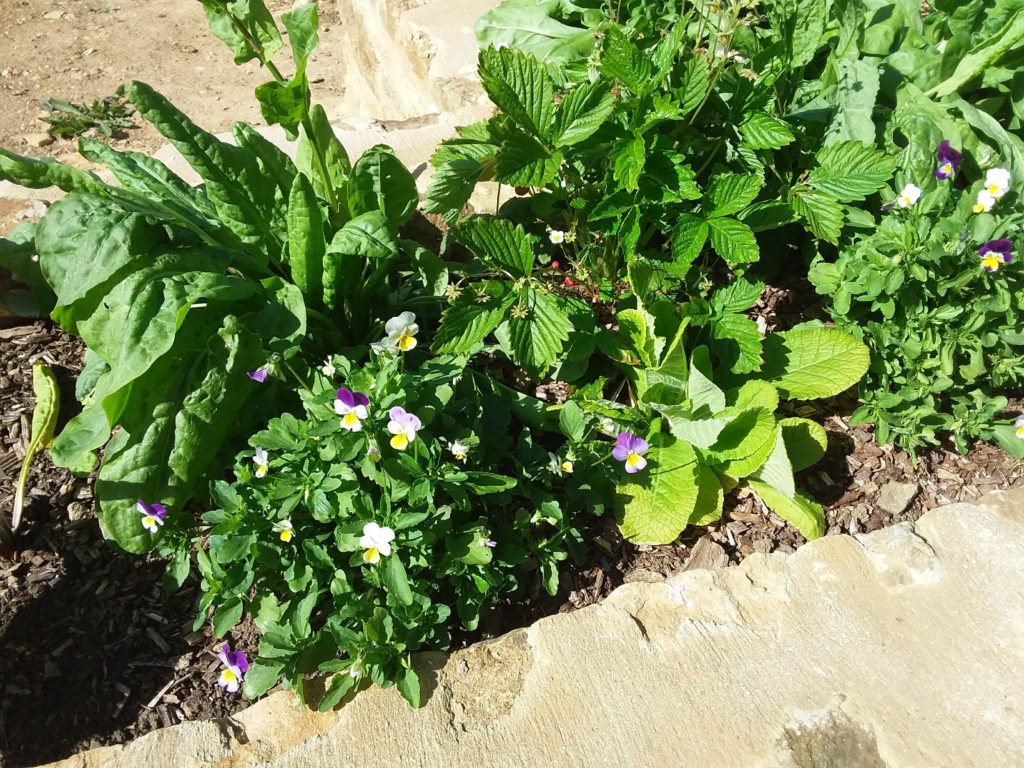
The heartsease are flowering, they look great! The viola tricolor is the wild progenitor of the cultivated pansy. There is alas no secure identification of heartsease in Anglo-Saxon literature, but it’s a lovely native wild flower with a history of medicinal use, so it’s probably reasonable to include it.
Heartsease, with sorrel, alpine strawberry and cowslip.
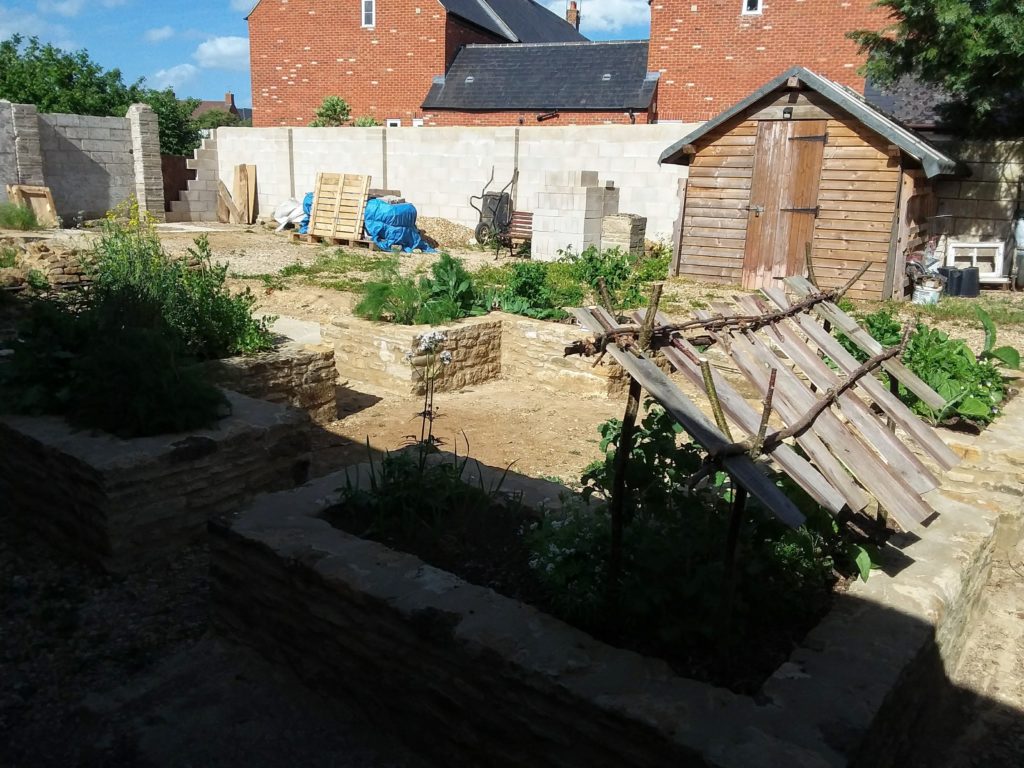
The main Rumwoldstow garden is really starting to fill out – I can see that next year I may need to remove some plants, or find them other homes – the oregano for example is disappearing under the opium poppy, even though it’s doing pretty well in itself.
Lilies, garlic and marigolds
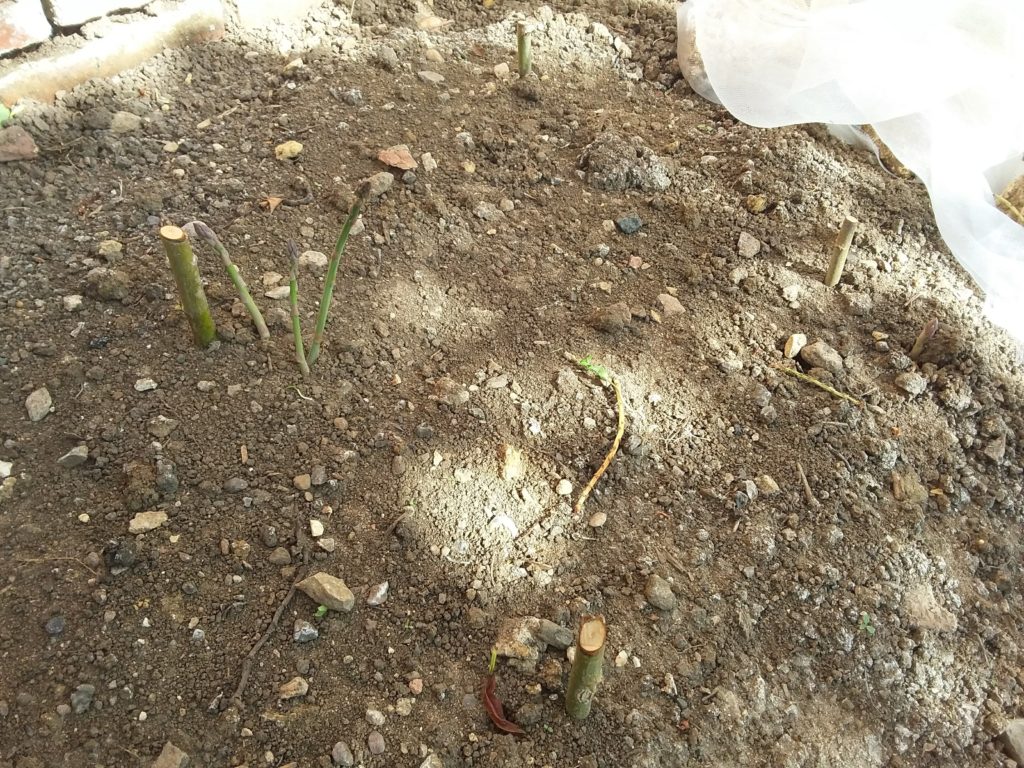
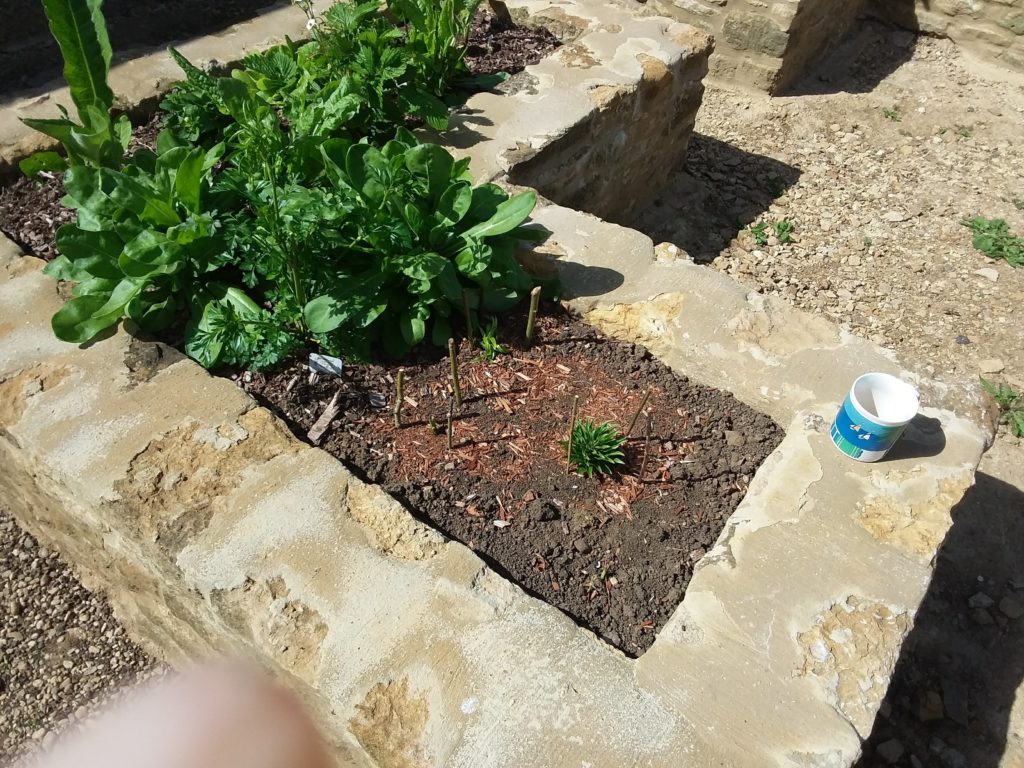
The asparagus plants in the Bed of Brother Julian are starting to come up. Subsequent to this photo, I’ve scattered sheep droppings around them and then layered lawn cuttings on top, with a sprinkling of soil at the end. T’internet tells me that sheep droppings are great for asparagus but that they may burn the plants. As these were fairly dry I hope they will be OK, and have tried to keep them from touching the actual plants. Fingers crossed!
Asparagus shoots
Asparagus is another questionable plant. It was definitely used medicinally, and it’s hard to see why the Anglo-Saxons wouldn’t have eaten the tasty shoots, but we don’t have firm evidence of this. It may be that the earlier varieties weren’t so good to eat.
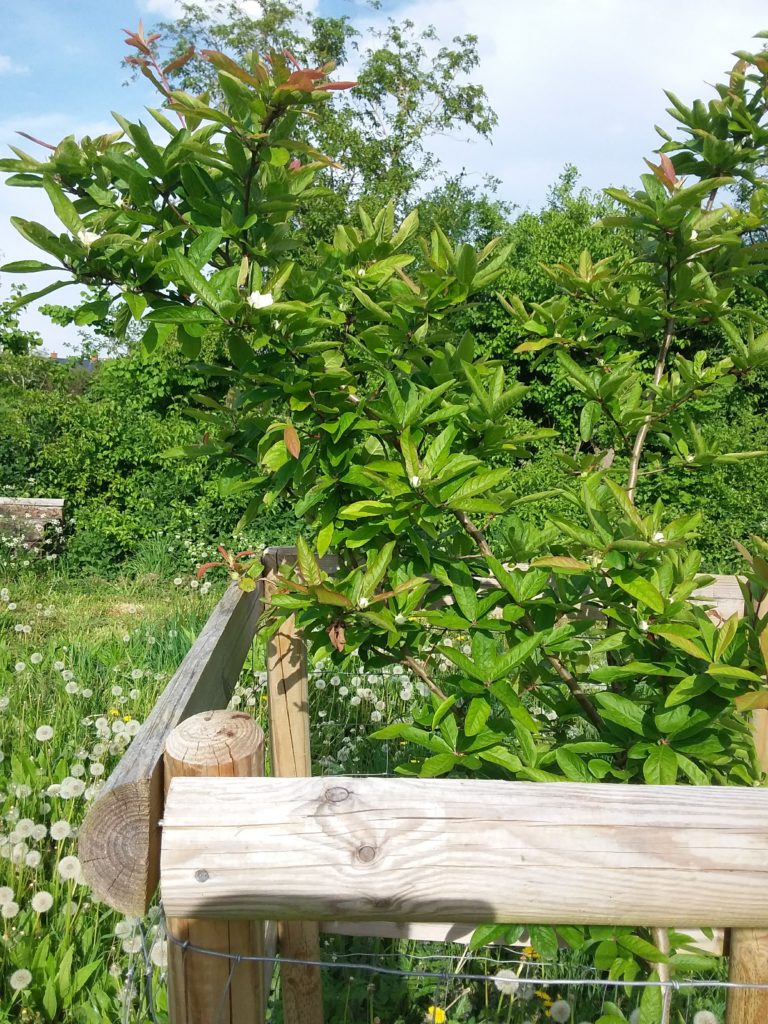
Two frosts this week means no plums or damsons, and maybe no pears. But the medlar is in full flower, here’s a picture from a few days ago. The flowers are white and a bit like a wild rose.
Flowering medlar
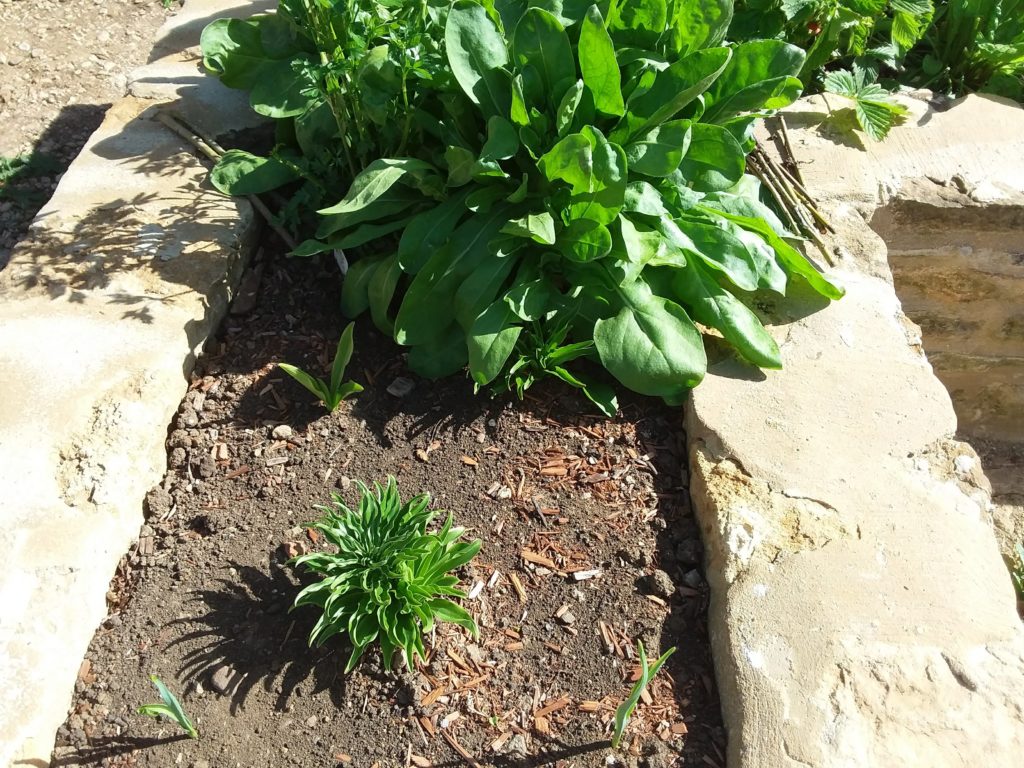
The madonna lilies are all up! The third one is still a tiny sprout and the second has a mystery companion which seems to be some other kind of bulb. Was it in the soil below, in which case it’s come up a long way? Or was it somehow stuck to the lily bulb? I may investigate in the winter but for now I’ll let it do its thing and hope that it will reveal its nature some time.
Trio of lilies, with mystery companion, also finger (I’m rubbish with cameras)
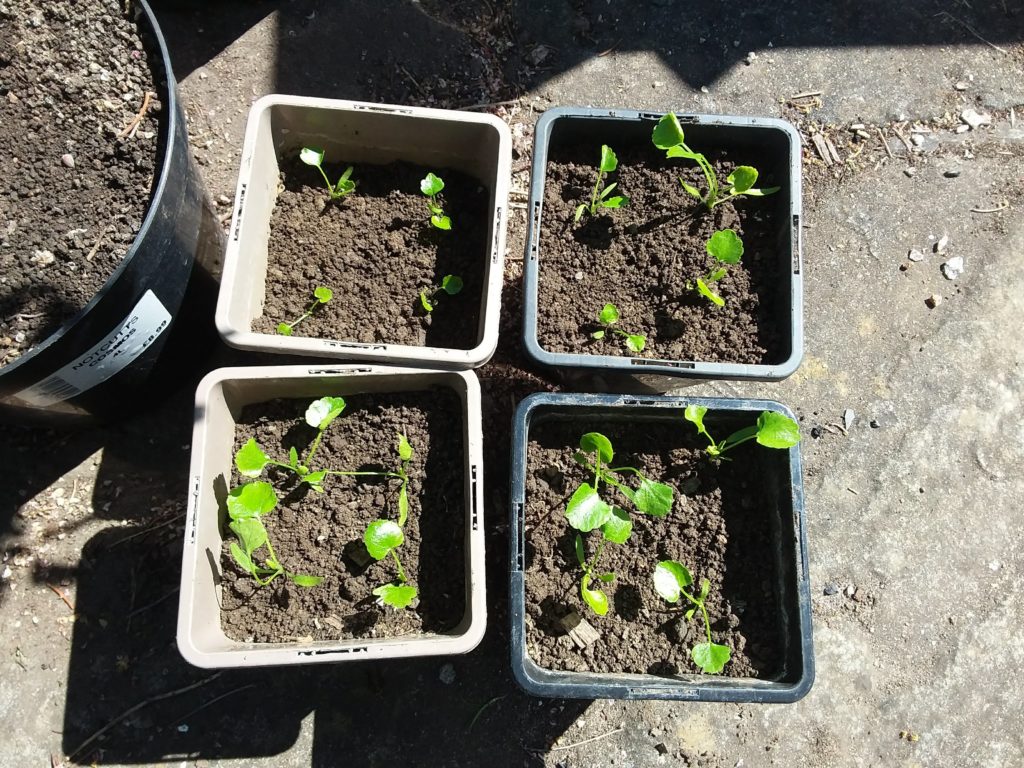
I still have some spare skirret seedlings and somebody a few villages over wants them, so today I potted them up, carefully separating the little seedlings. I planted them too close together because I had no confidence in the germination rate, which in the event was very good. Fortunately they seem to be tough little critters. They are now four to a pot and I hope will be fairly easy to plant out once they’re bigger. I still have 16 seedlings left for myself and will have to dig out some space for them real soon now.
I confess, I potted up the biggest seedlings and gave up on the final tiny four which have gone into the hedge and do not appear in this picture.
Skirret seedlings of varying sizes
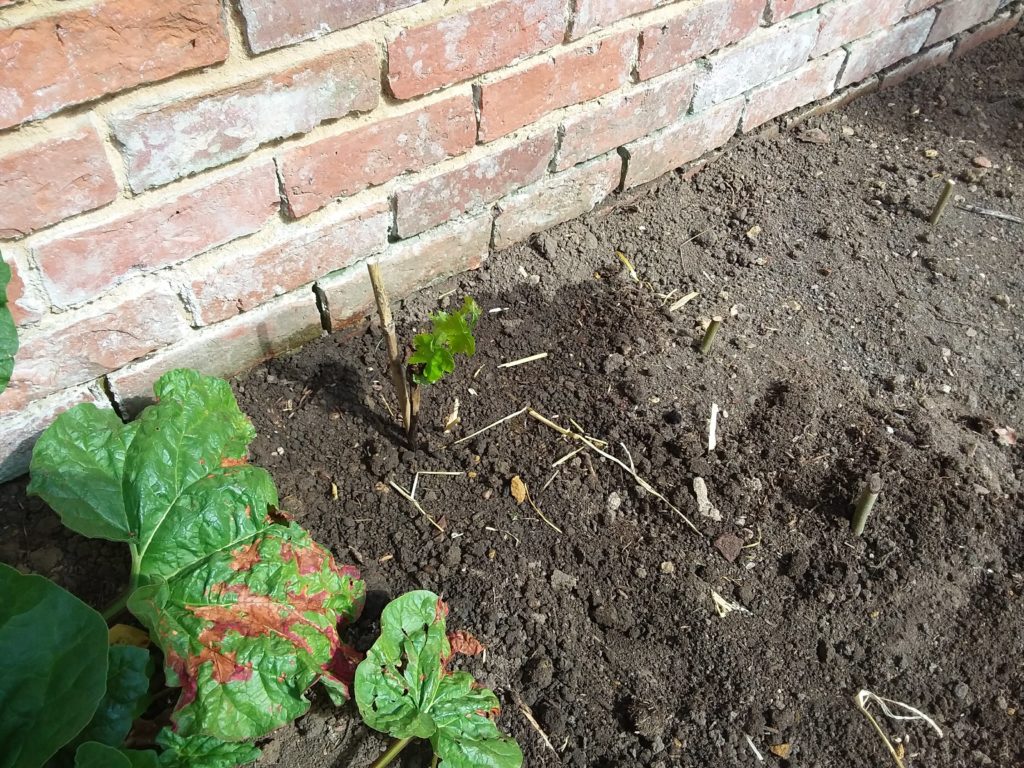
My grapevine arrived in the post today! All good monasteries should have a grapevine. I chose a Van Der Laan white grape, a Dutch variety which is apparently a reliable fruiter even in the UK and suitably hardy. Planting that out in the Bed of Julian cheered me up some. If it flourishes, we could go Greek and try stuffed vine leaves, maybe with Anglo-Saxon fillings?
It’s between the rhubarb (yeah I know, but it had to go somewhere) and the asparagus, which is still hiding.
Newly planted Van Der Laan grape vine (just pretend you can’t see the rhubarb)
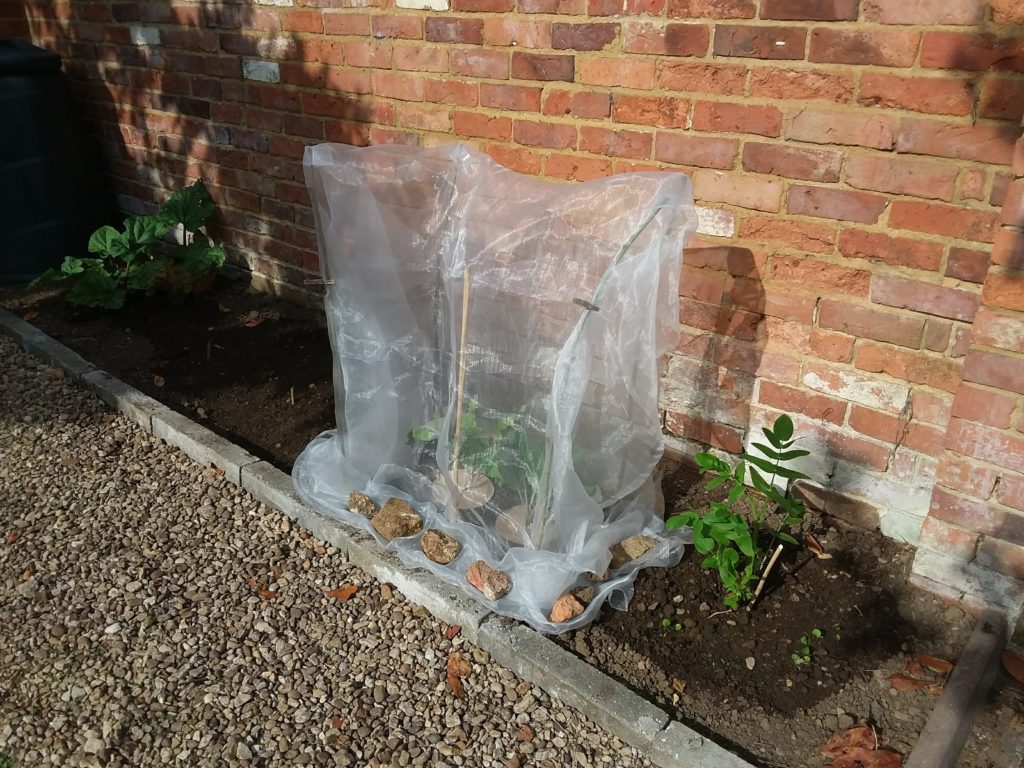
Here’s the other end of the Bed of Julian with two Nine Star Broccoli plants in netting to keep off butterflies, and mama skirret with some babies around her. The broccoli is a perennial that should last four or five years and produce cut-and-come-again mini cauliflowers, with the leaves being edible also. The variety seems to date from the early twentieth century1.
Nine Star Broccoli and skirrets
The Anglo-Saxons has plenty of words for various brassicas, though obviously they wouldn’t have grown this variety. I don’t know how they’d have dealt with caterpillar infestations though – I think people didn’t actually know that caterpillars and butterflies were connected, so they’ll have had no idea how to prevent the eggs being laid. There’s so much knowledge that we take for granted now but that was utterly non-obvious for hundreds, maybe thousands of years prior to microscopes and leisured scientific observation.
Alas. One late frost, in early May, and the damsons and plums are gone. There are one or two left, but most are now sad shrivelled brown splodges instead of the firm swelling green fruits of a week ago. The farmer’s life is hard – imagine the disaster when this is your livelihood. No photos as it’s too depressing!
What did the Anglo-Saxon orcharder do? Did she shroud the trees in straw or cloth or something when it looked like being frosty?
The pears have suffered too, but I think there are still some left, and the older apple tree may be OK. The quince still seems to have tiny fruits, and the medlar is flowering and apparently perfectly happy. But I grieve for my little damsons.
The only comfort is that I now have no fear of my young trees exhausting themselves by over-producing fruit while still only two years old.
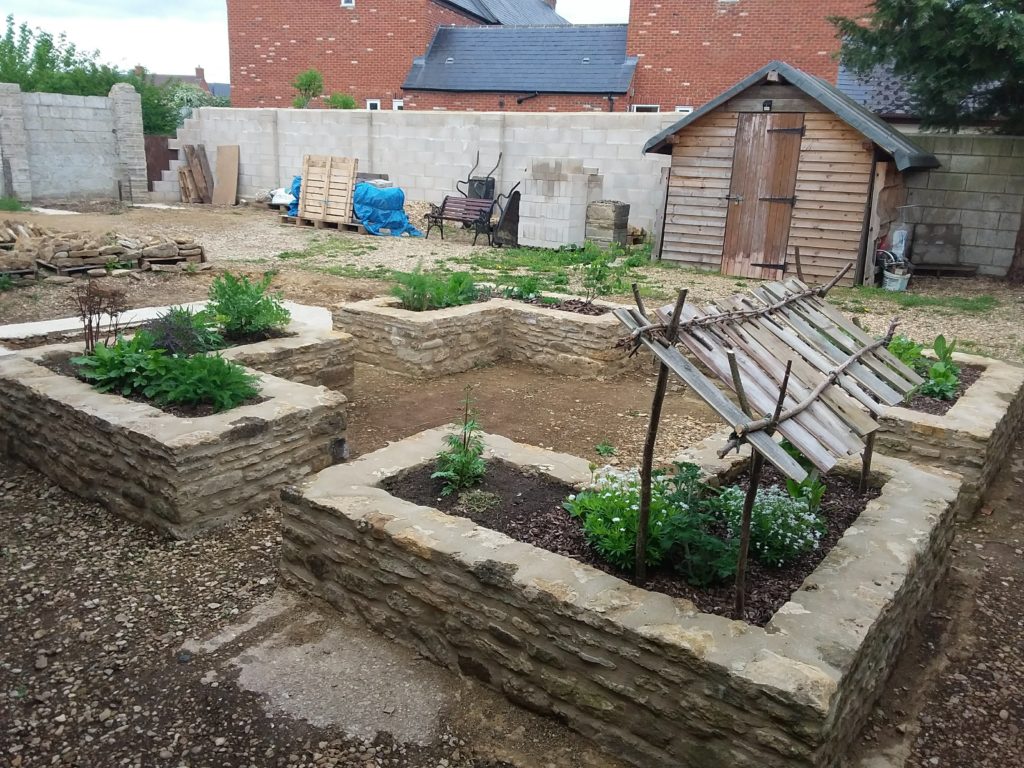
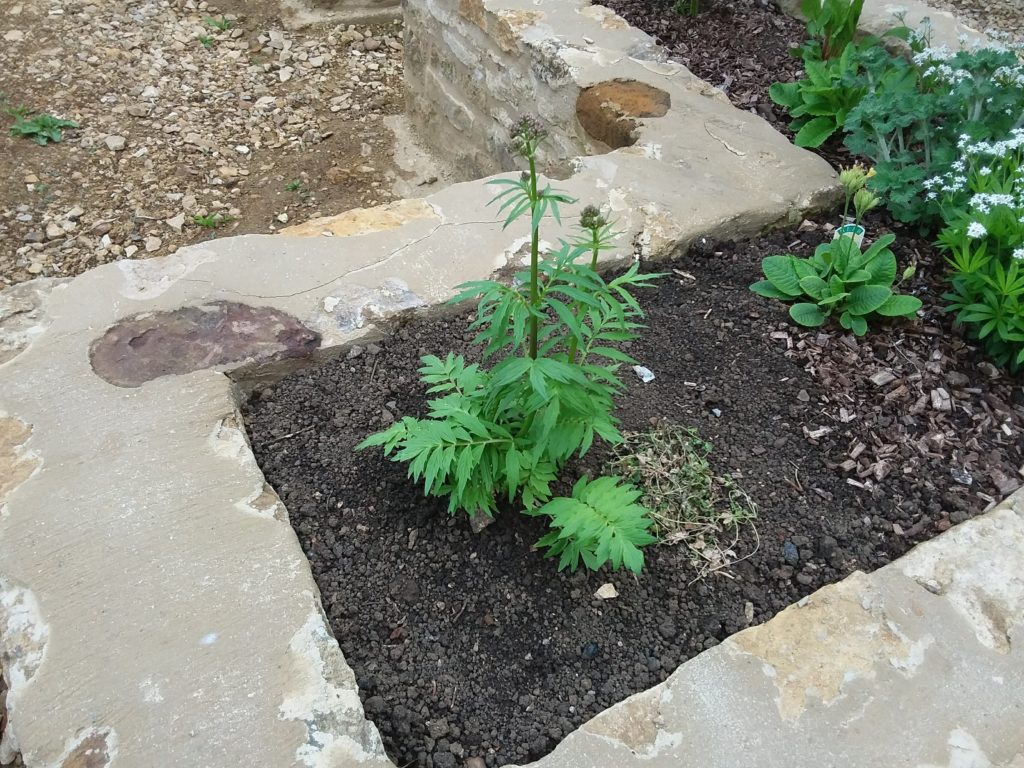
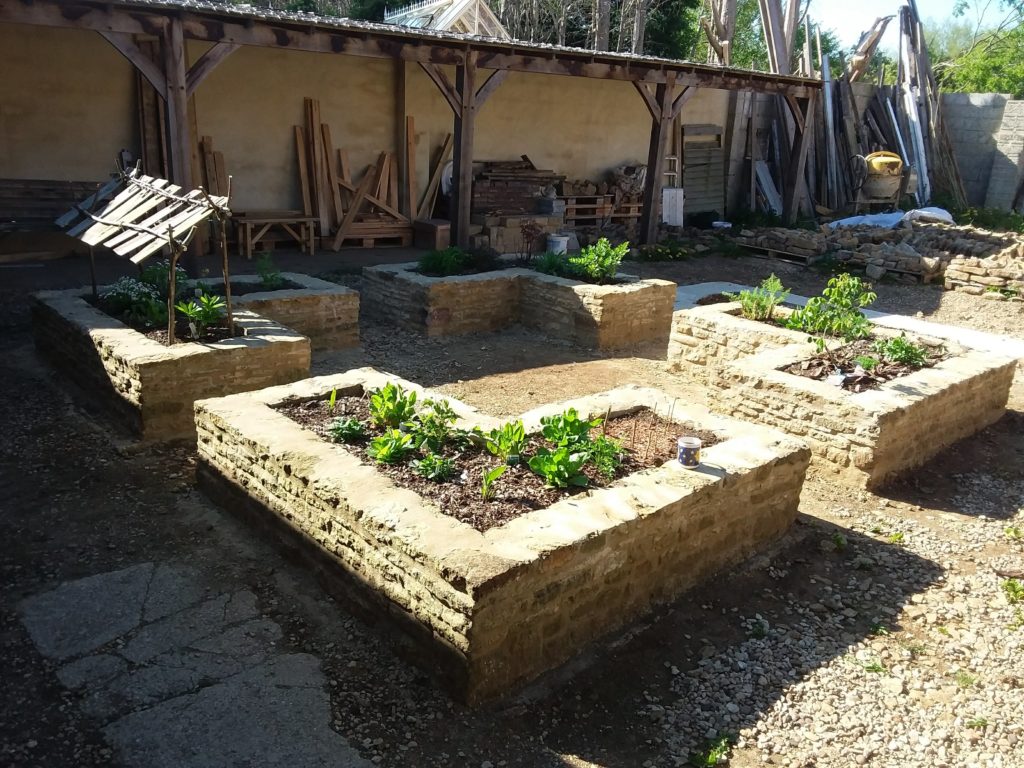
After several days of rain, the weather has cleared up and the garden is coming on well. The photo below is taken from the cloister looking at the not-so-pretty side of the garden. The newest planting is the valerian, which is at the left end of the nearest bed, the one with the little roof. It’s fixing to flower soon.
Medicinal valerian
At last, there is a sign of life from one of the Madonna lily bulbs which I planted several weeks ago. It’s late in the season to plant them and I don’t expect great flowers this year but at least something has started to come up. I have been determinedly not allowing myself to dig down and see what’s happening…
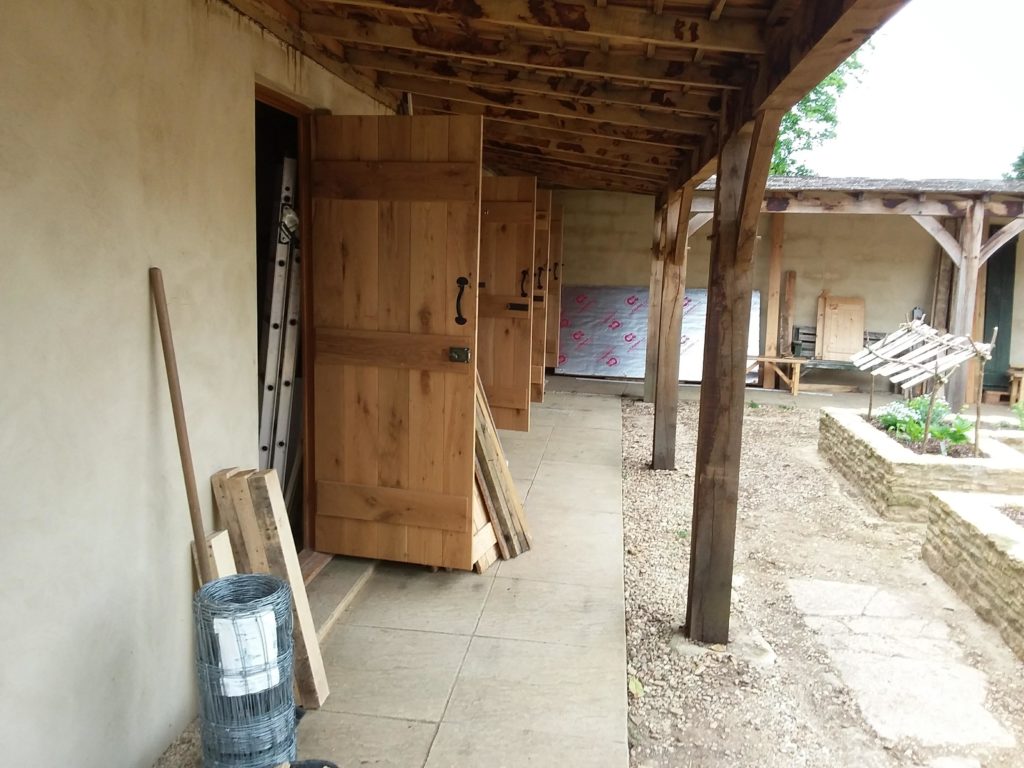
Did I mention that over the winter, all four doors to the outbuilding rooms swelled in the unprecedented damp and wouldn’t open for six months? And that after the rain finally stopped, in mid March, brother Alf kept trying the doors and seeing how they were beginning to shift in their frames. Finally the left-most door opened (which meant Al could get into the storeroom and get hold of his good drill at last!)…then the next left…then the third door…but the last door to the planned scullery remained firmly sealed shut. Woes! Brother Alf optimistically foretold that it would open at Easter, as a miracle. Good Friday…Easter Sunday…went past. But on Easter Monday the door opened, and Al has been able to get to work fitting out the scullery.
All four doors open!
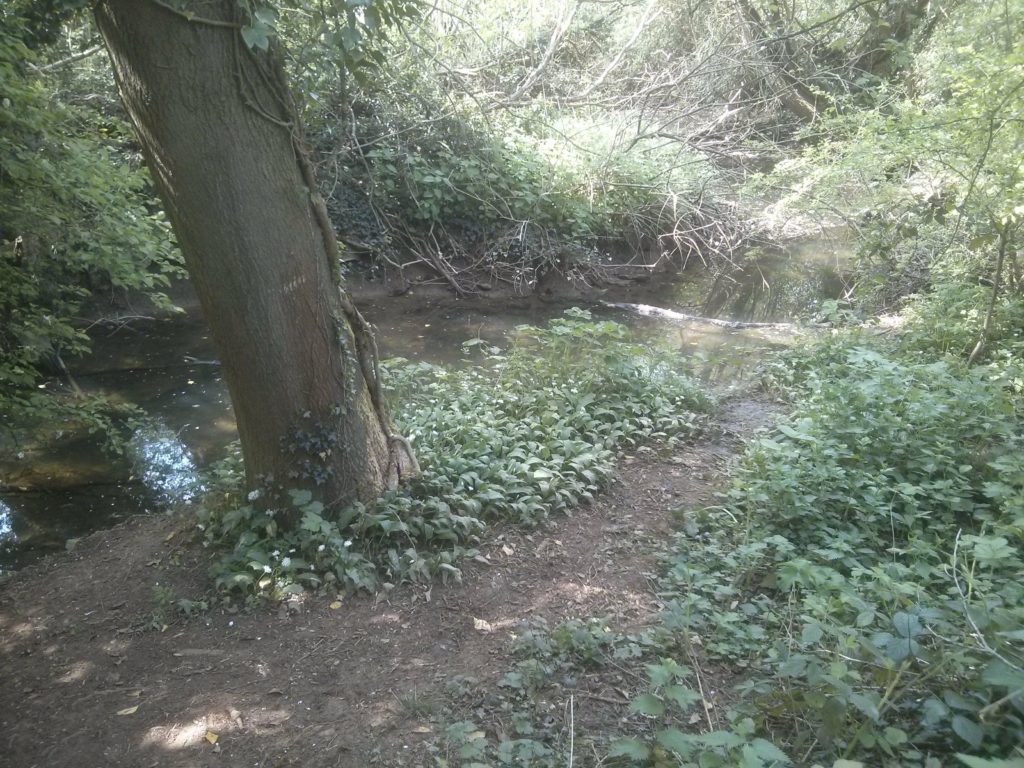
About a kilometre from Rumwoldstow, my nose alerted me to a fine cluster of wild garlic by the brook. I only hope mine will do as well in the garden. I’m a bit worried about it getting too hot – the sunhat doesn’t entirely protect it.
Wild garlic. Wild? It was livid!
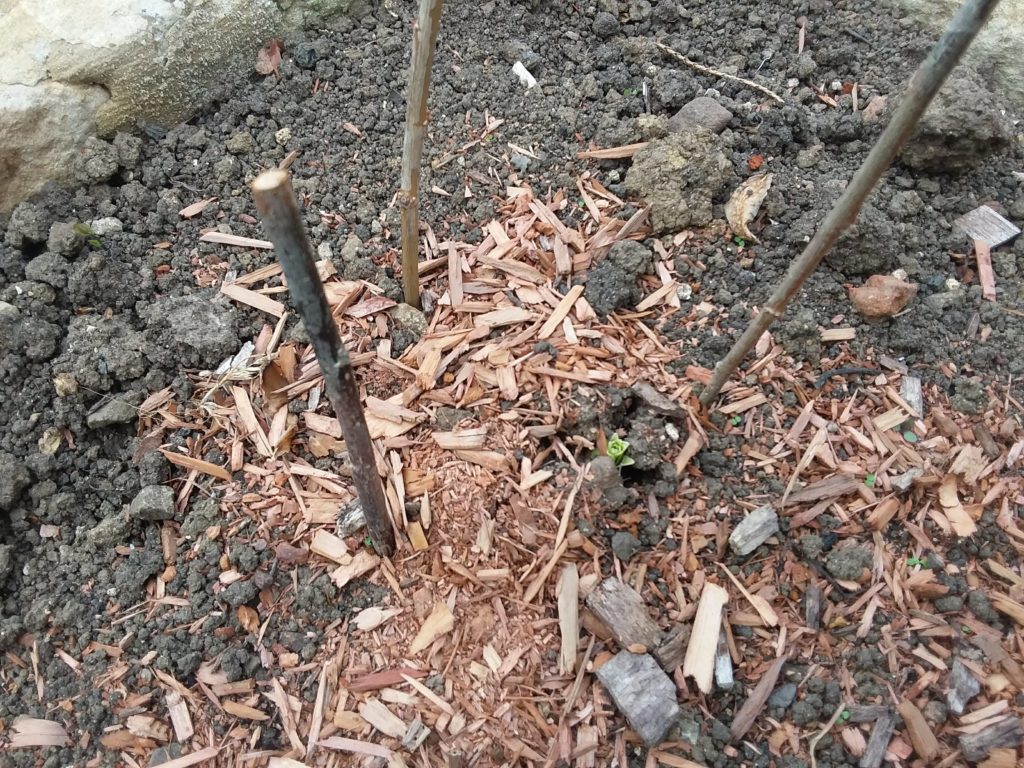
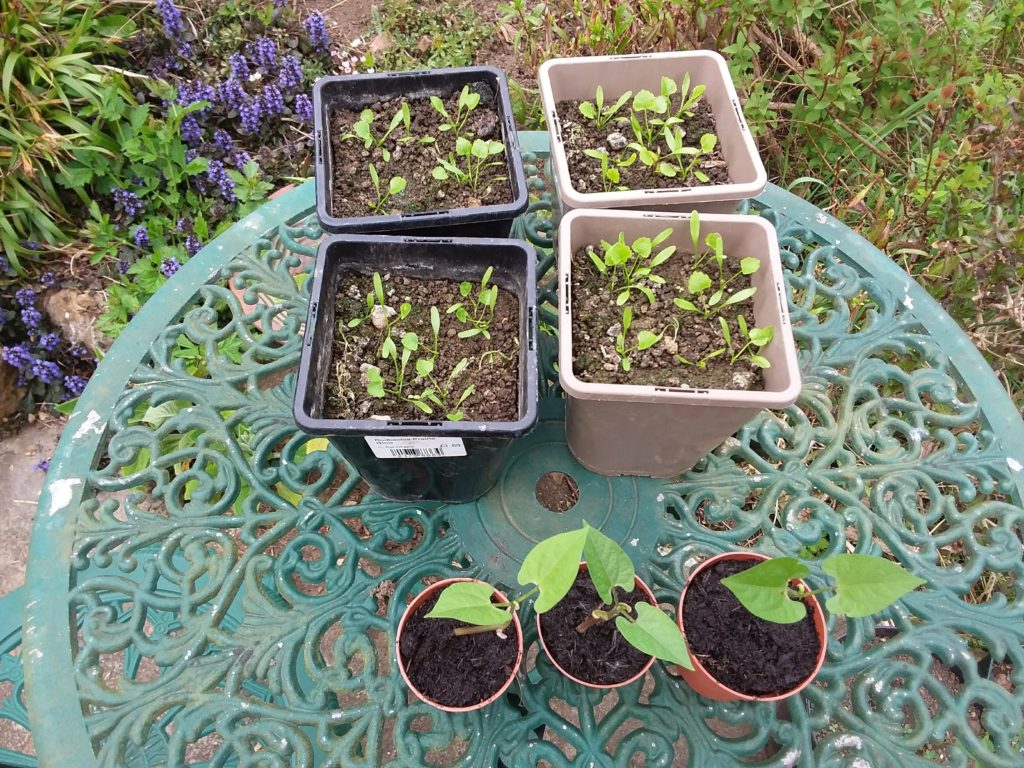
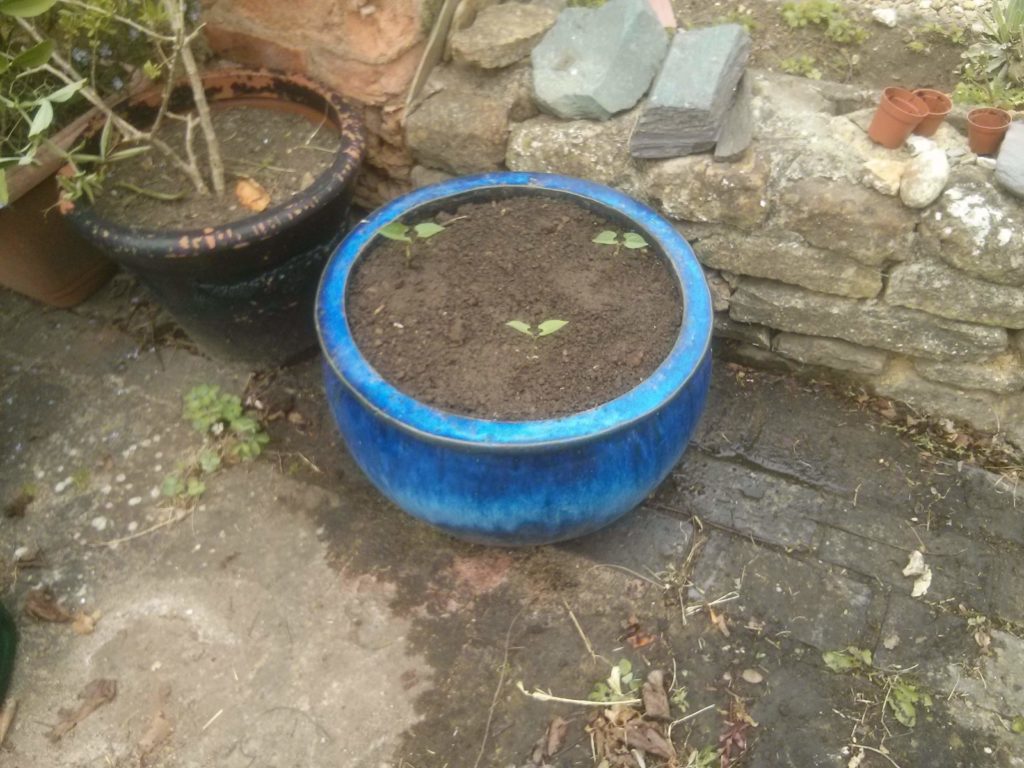
I planted eight pots of skirret seeds that I collected last year, and four pots have germinated well. When they’re a bit bigger, I plan to very gently try and separate the strongest and move them into the pots of failure. Only the strongest skirrets can make it in Rumwoldstow!
A kind neighbour gave me some dwarf french bean plants. The Anglo-Saxons ate various kinds of beans, I don’t know how similar they were to anything we’d recognise but at least it is beans. In return I gave her a spare garlic bulb from those I planted the previous day, mostly around the rose in the monastery garden as I’ve been told this will help keep off greenfly.
Skirrets (above), beans (below)
The garden’s filled out a bit but there is still no sign of the three madonna lilies which I planted in the bare area behind the mug. I am so far resisting the temptation to excavate and see if they’re sprouting at all…but it’s hard! What there is, is lots of bindweed shoots. Some are growing from bits of root we didn’t manage to sieve out when filling the beds, and some is in the plants like the fennel that I transplanted. I’m pulling out each sprout as I see it, and hope that eventually they’ll give up.
Green beans potted up (in the home garden, not Rumwoldstow)
I just had to check on the sheep…yep, still there!
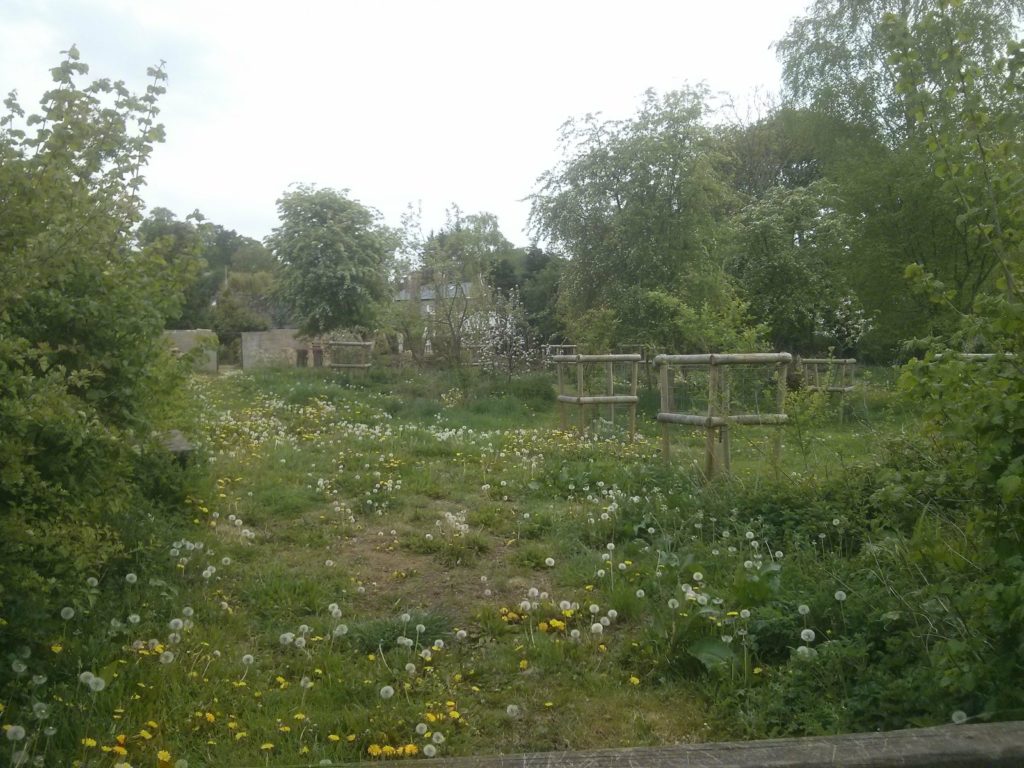
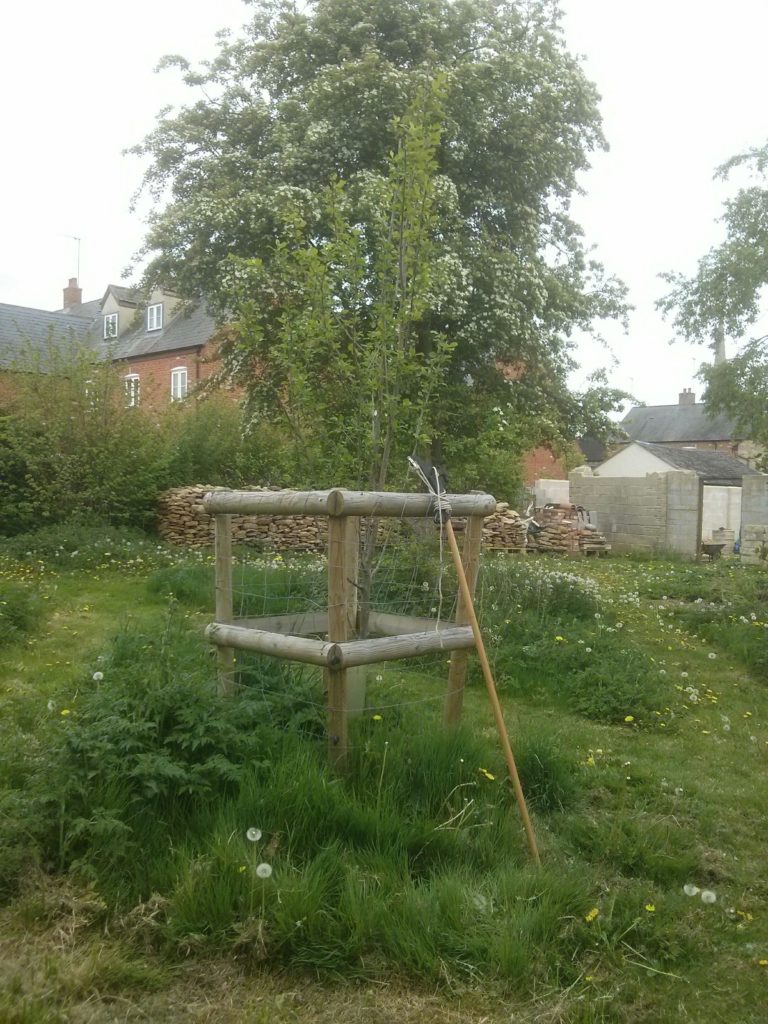
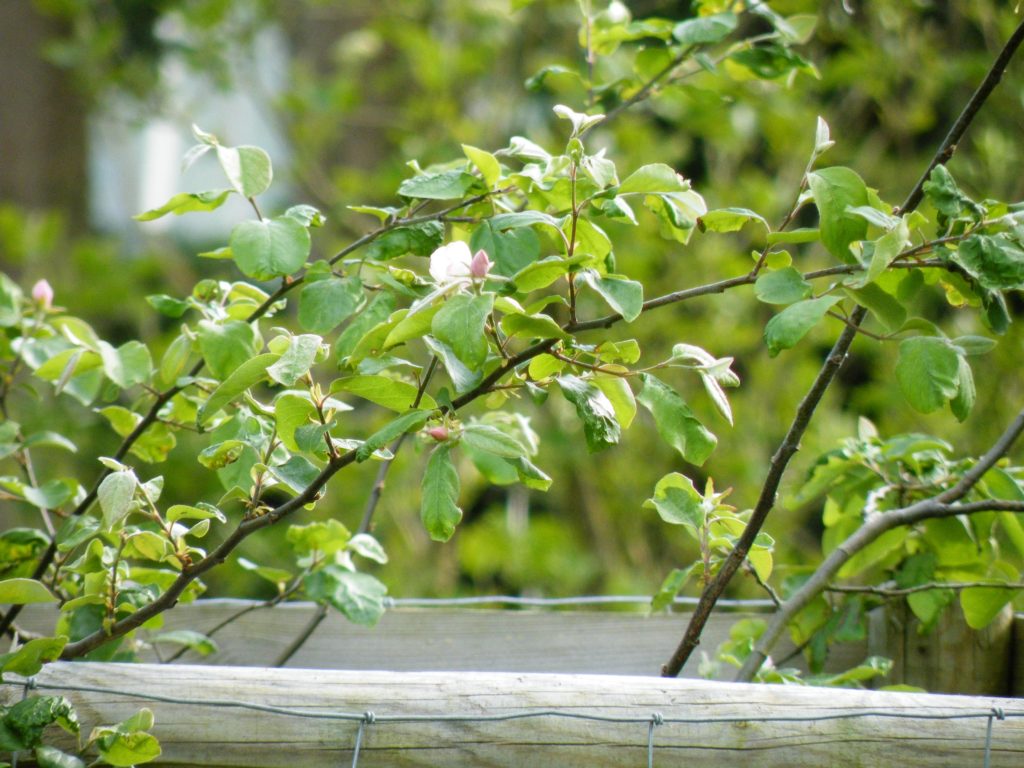
Back in the orchard the dandelions are turning into clocks. But people won’t have called them clocks back in Anglo-Saxon times! I wonder what they did call them? The quince is in full flower and just starting to look as though it may be setting fruit.
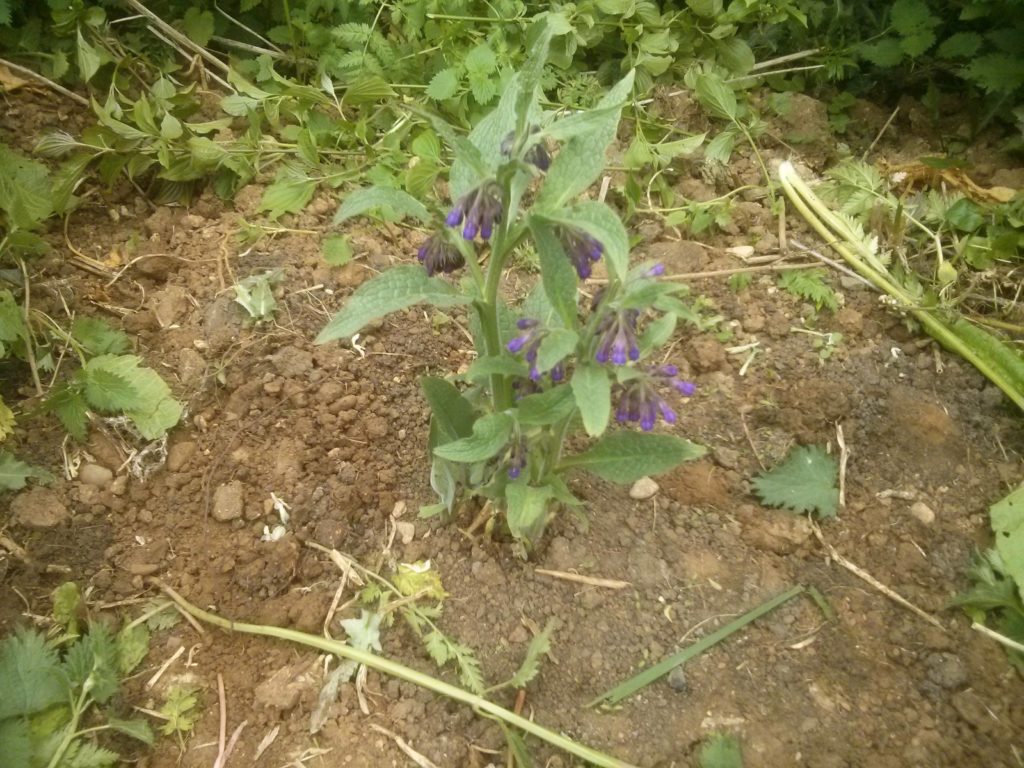
I dug out some of the dock and nettles to give the comfrey which I transplanted into the orchard a bit more light and space. It’s looking pretty healthy, and I hope that once it’s established it’ll be able to hold its own.
Comfrey in the orchard
Finally I took about a metre off one of the young damson trees, the one which is reaching for the sky. It still looks pretty tall. I used the very fine lopper on a stick which you operate by pulling a string. I’ll probably take a bit more off next year as I want all the fruit trees to stay fairly low so we can pick the fruit.
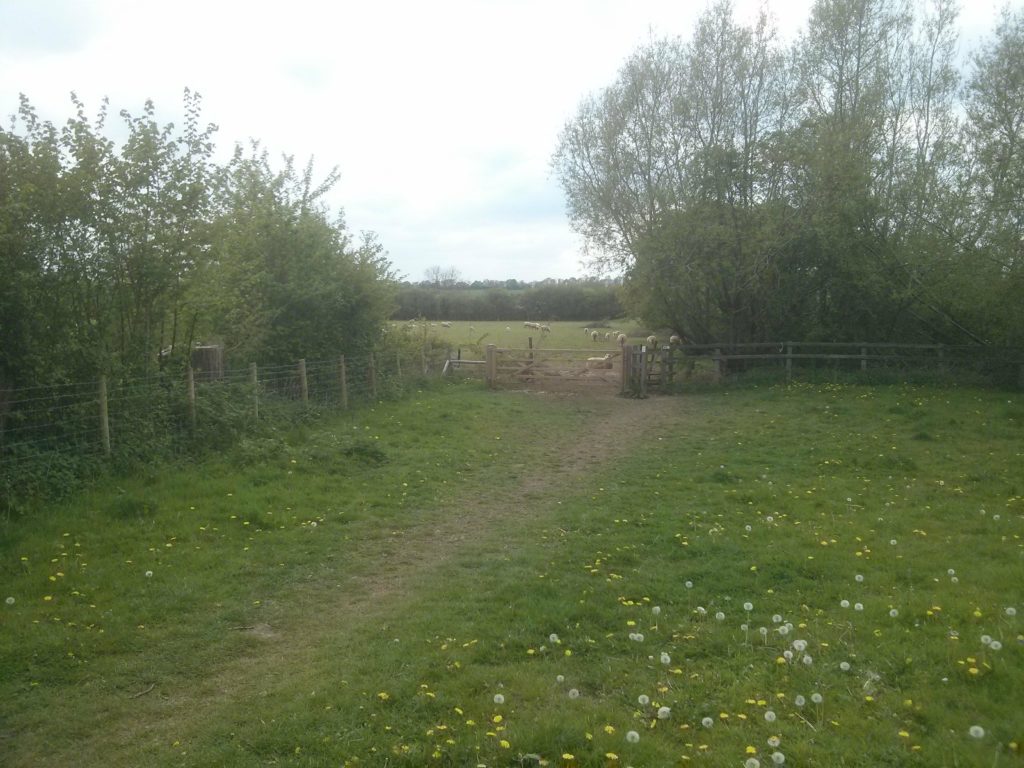
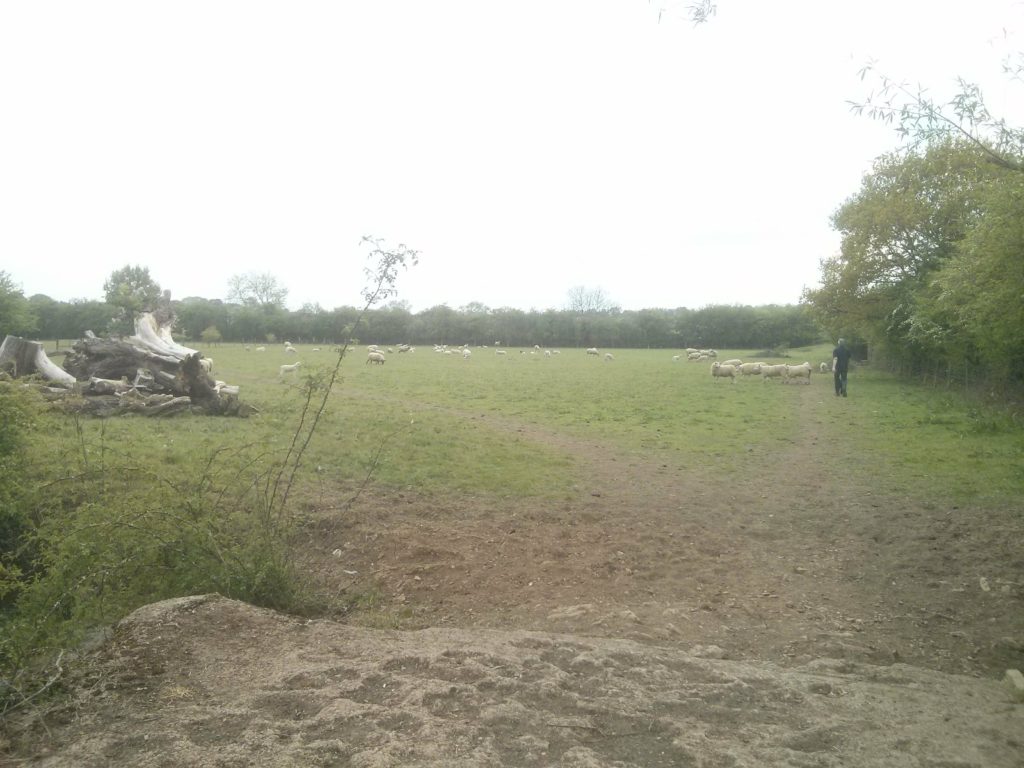
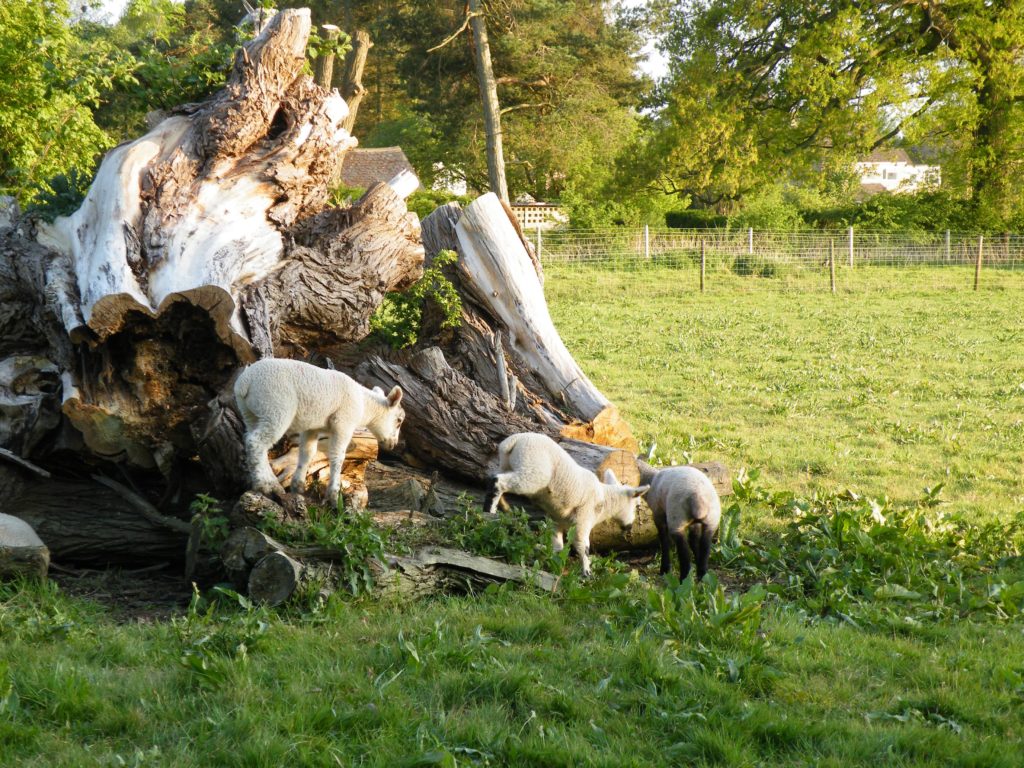
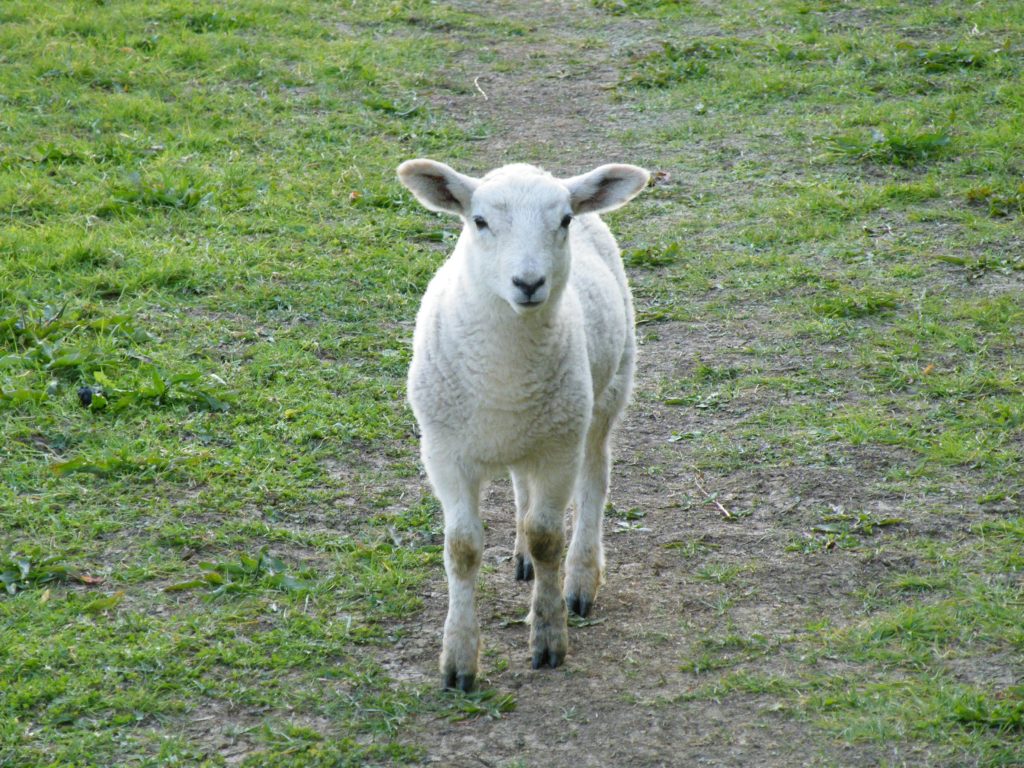
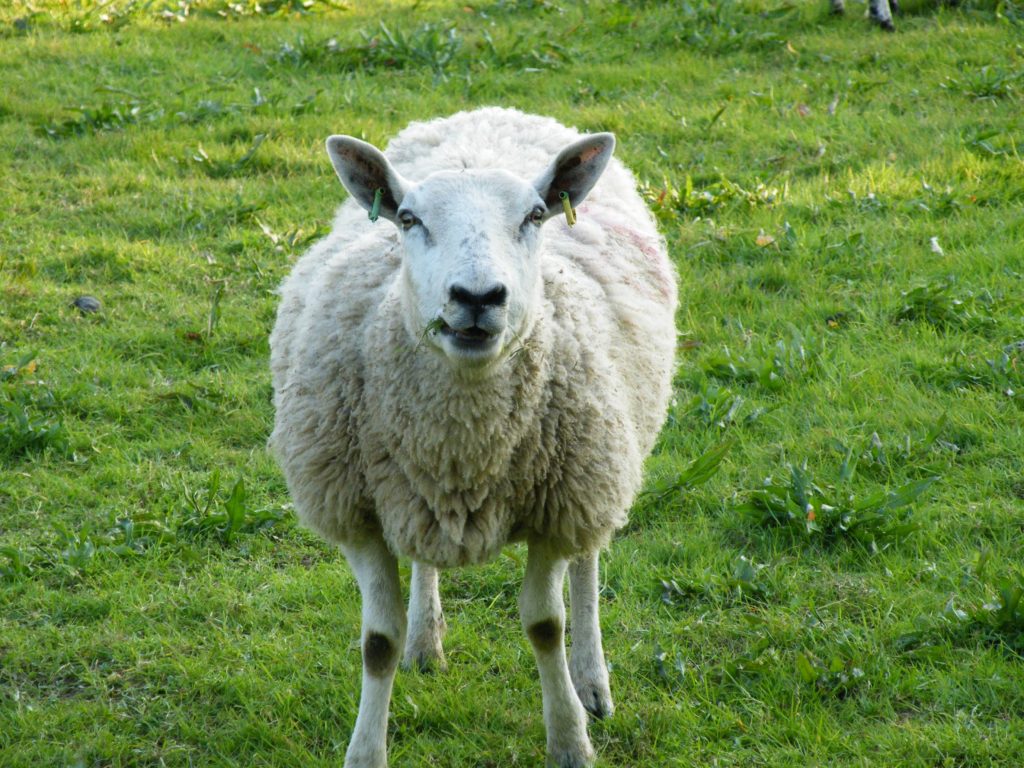
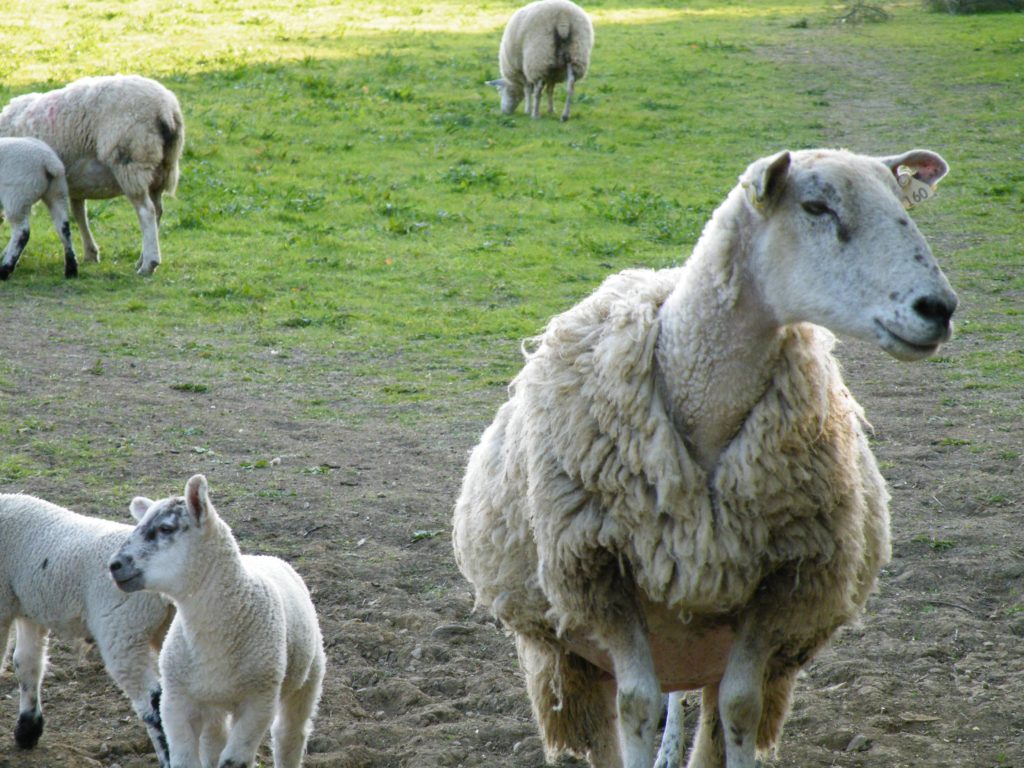
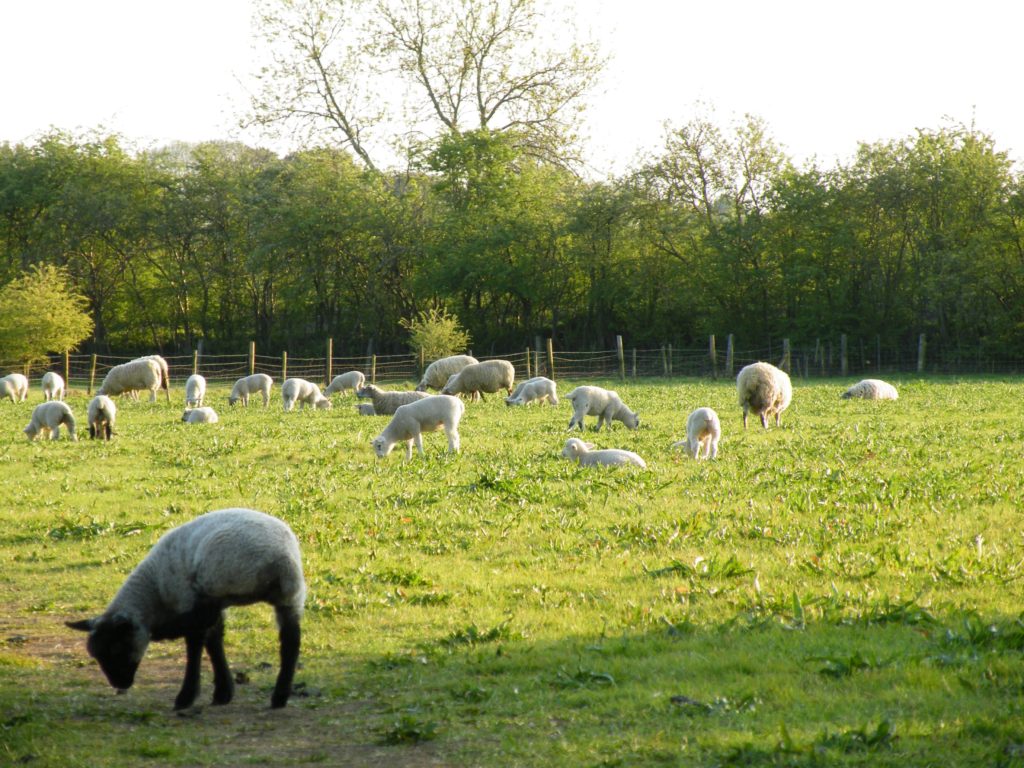
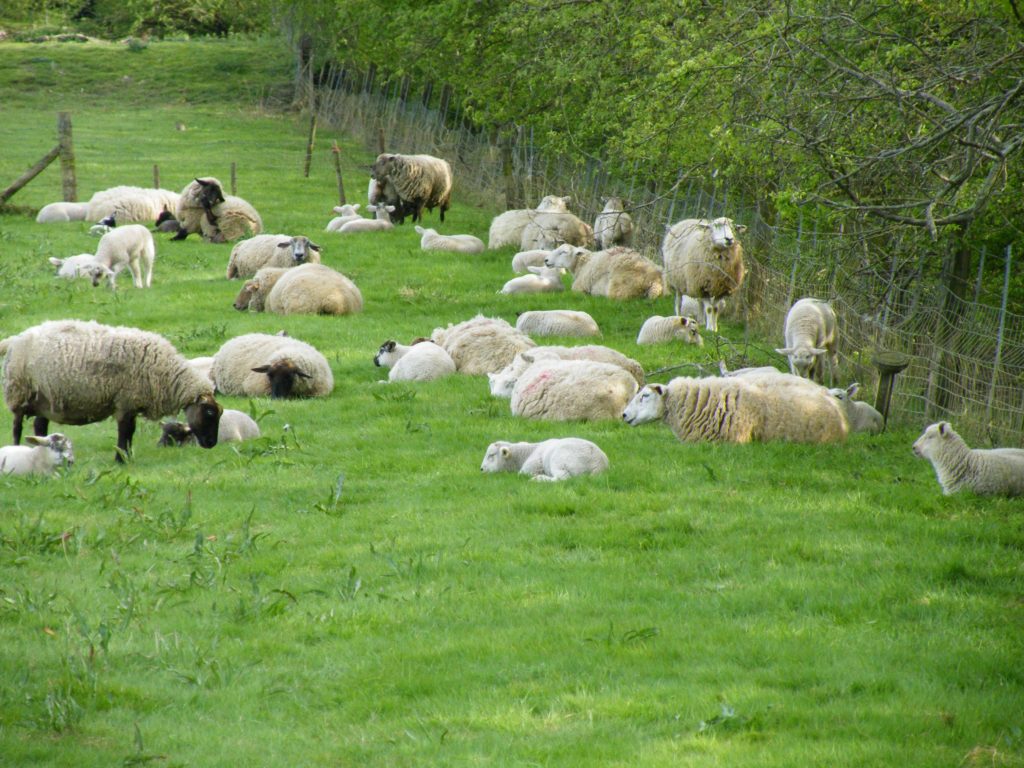
Now that Lake Meadow has dried out and the grass has started to regrow, the local farmer has moved a small flock of sheep down there. Particularly adorable are the four hand-reared lambs, who love a bit of attention.
Playful lambs
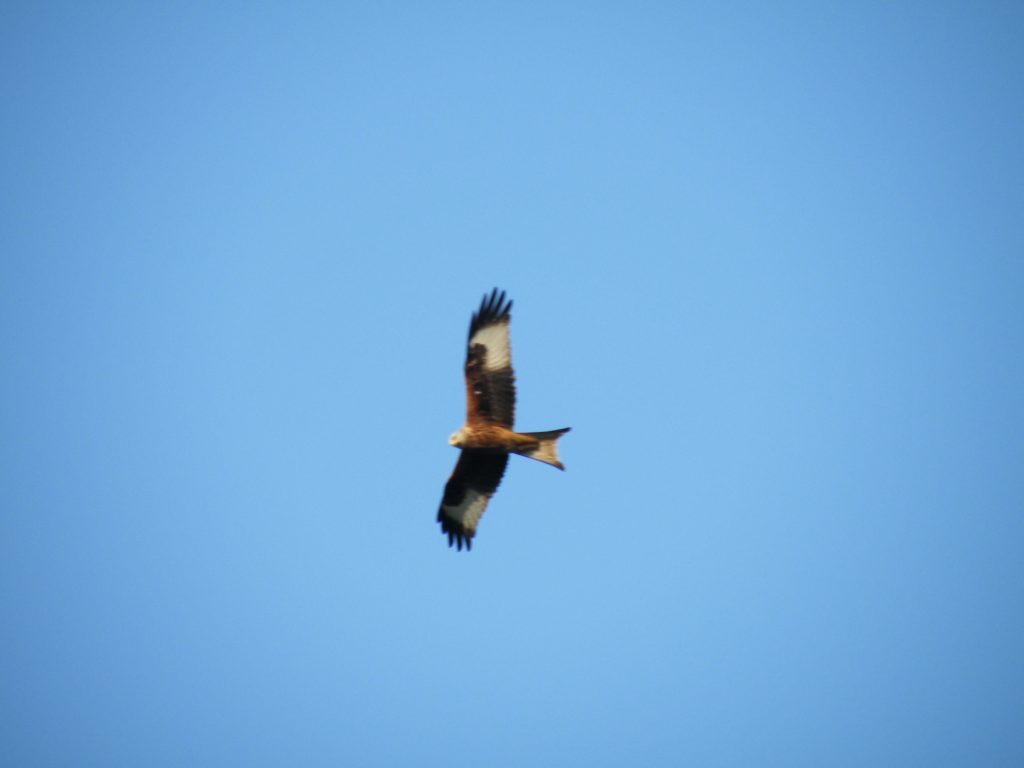
The local kites are nesting in a tree nearby after driving crows off their nest. I assume they’re interested in the health of the lambs below…but not in a good way…
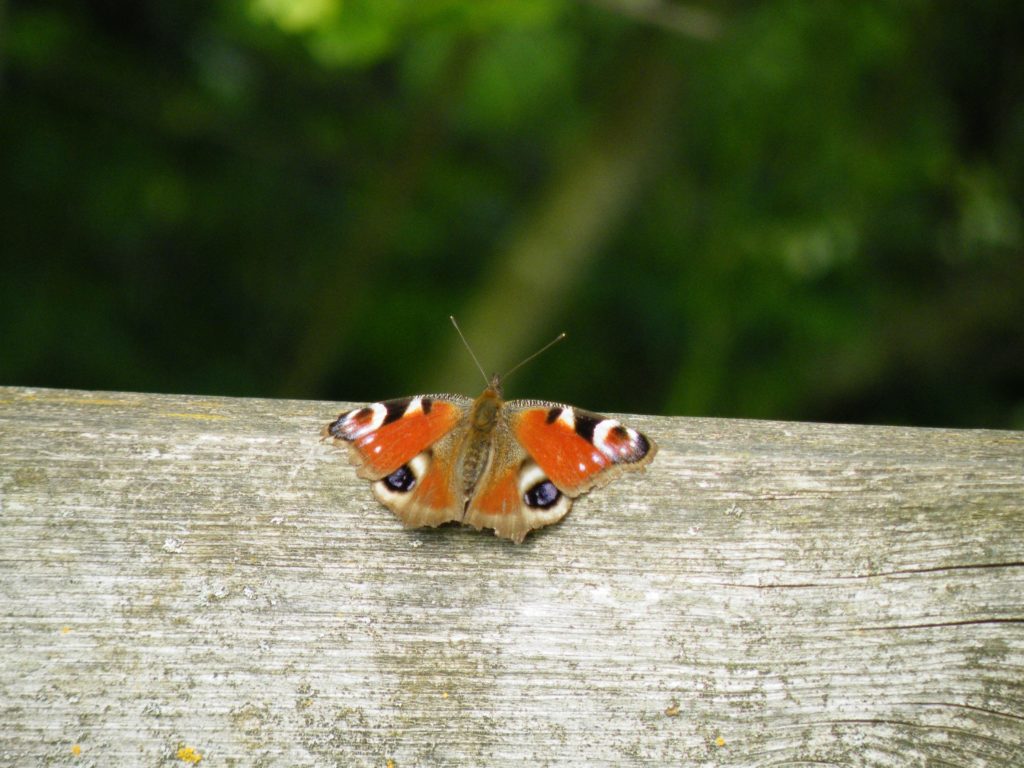
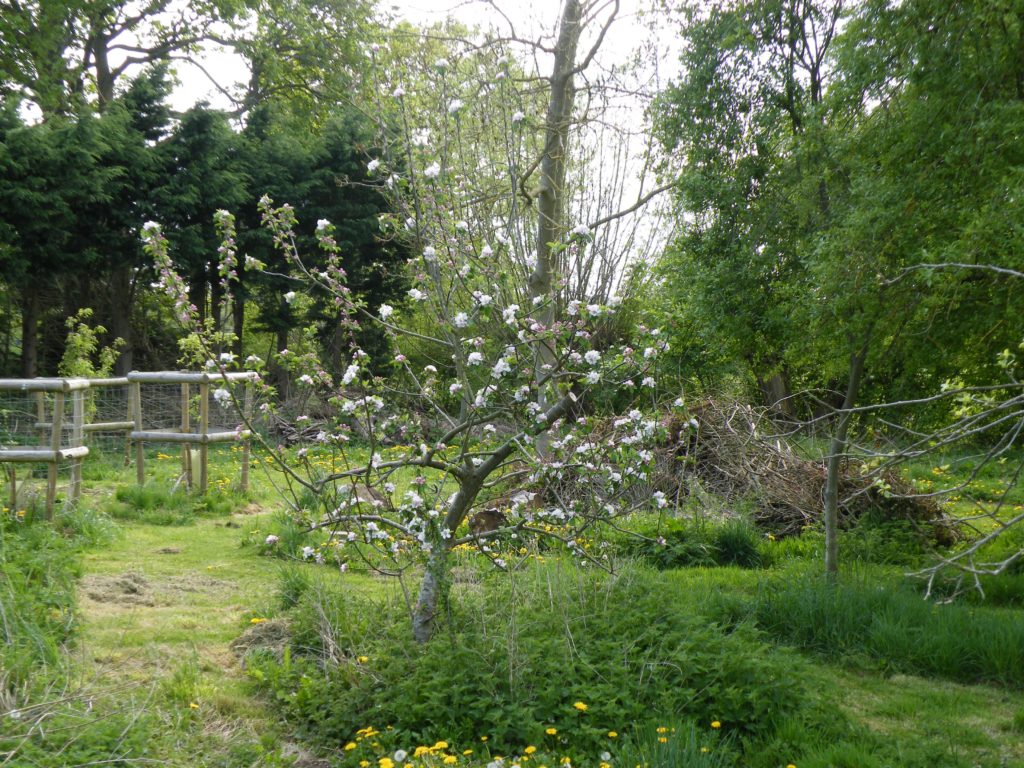
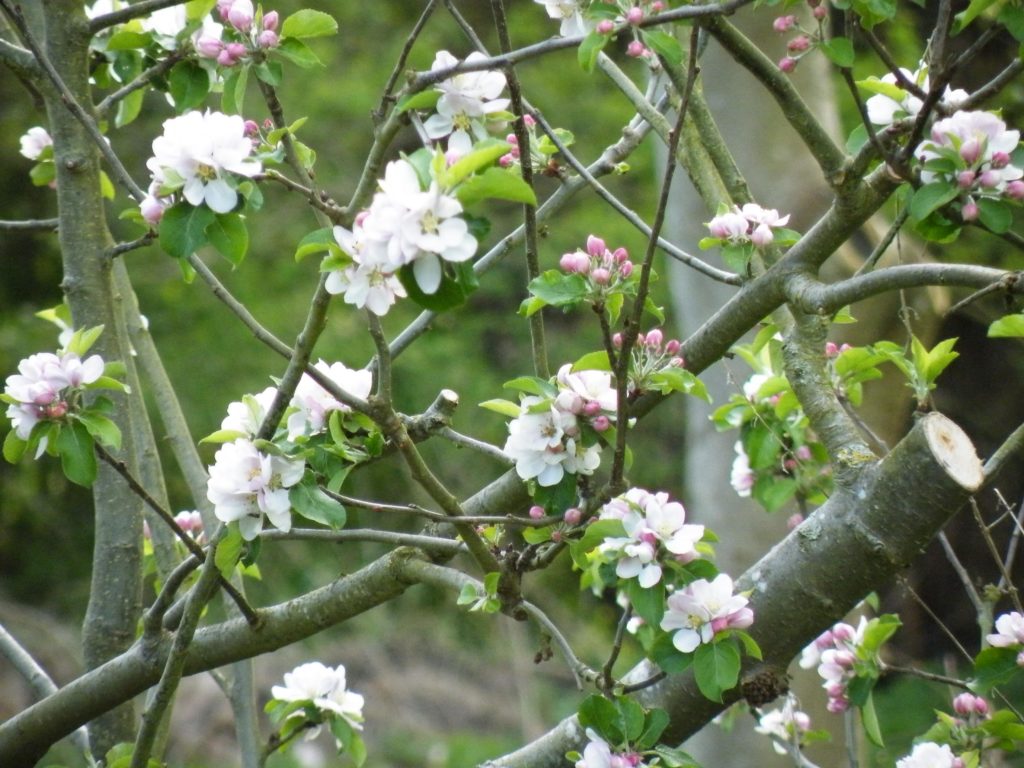
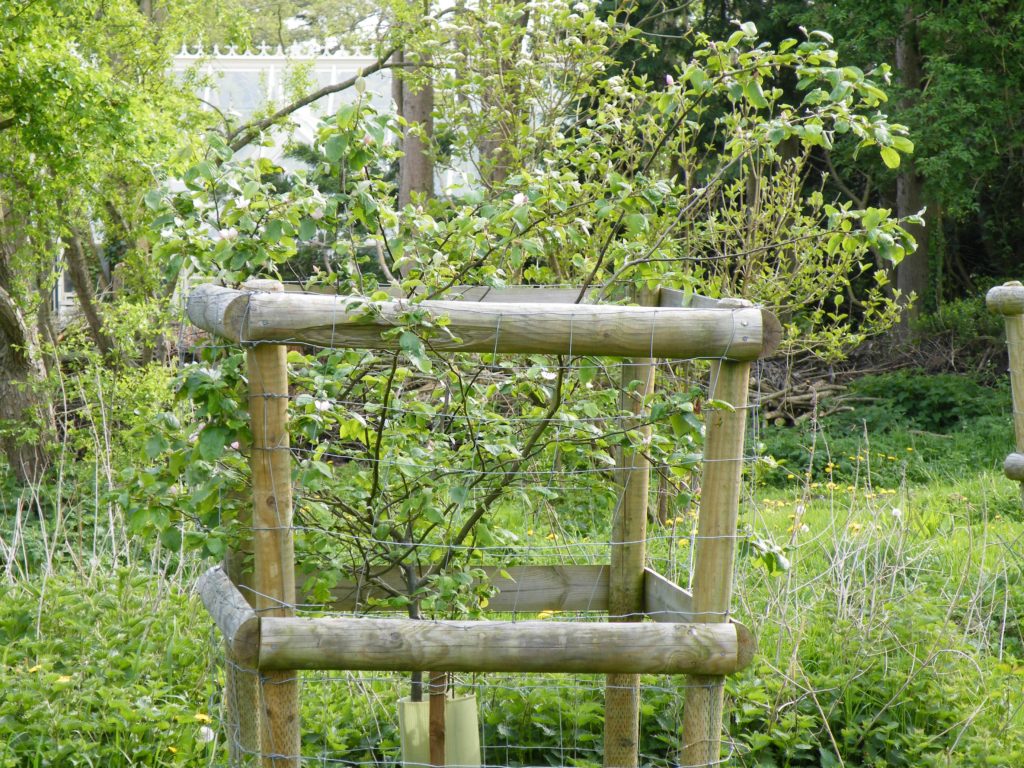
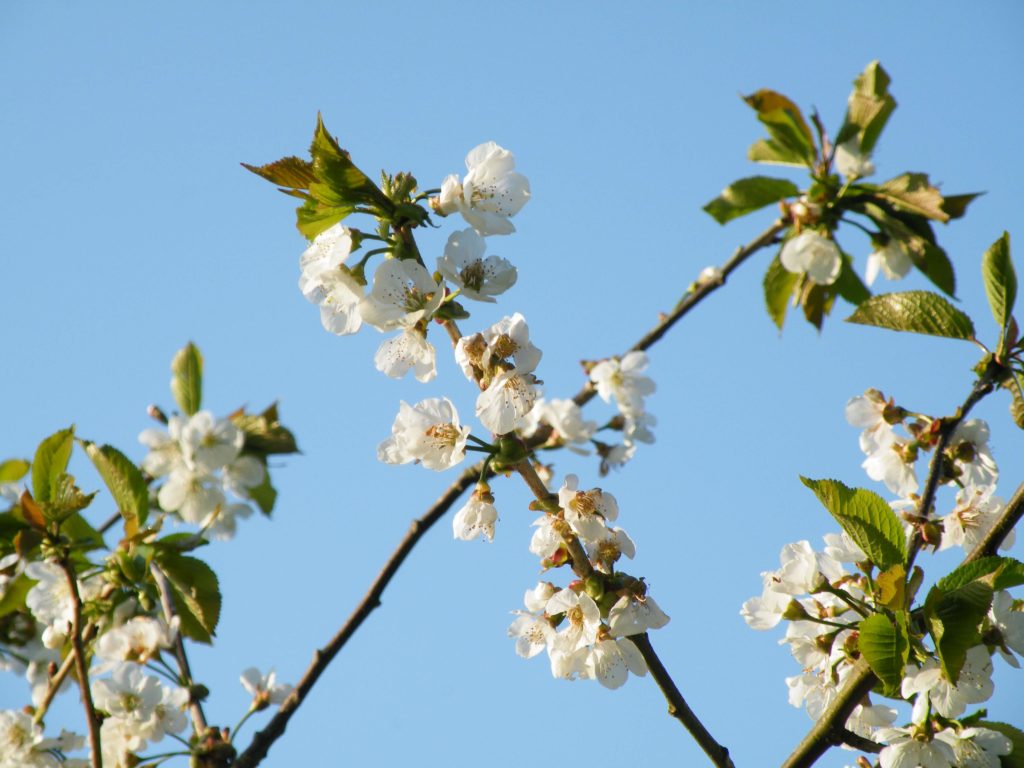
Red kitePeacock butterflyOld apple tree now in full flowerApple blossomQuince tree flowers starting to openNot very clear, but quince blossomCherry blossom
The medlar is still not in bloom, but has many tightly-closed roselike buds. And here is one last photo of the sheep, because sheep.
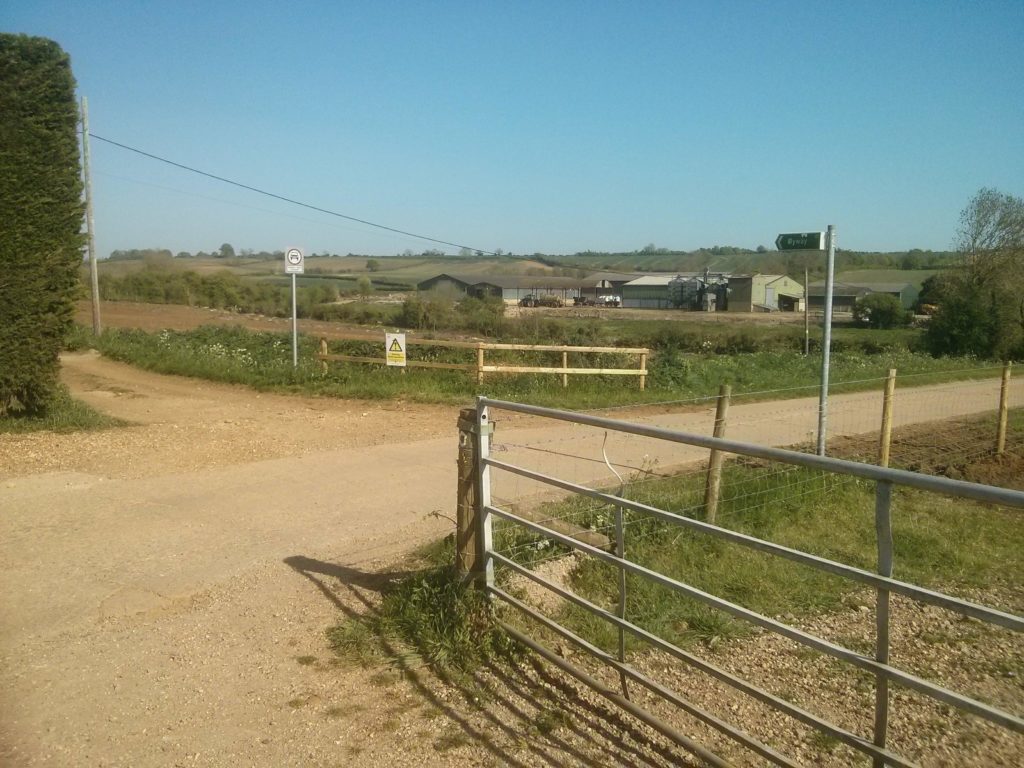
I walked to Walton Grounds, about 2km south of Rumwoldstow, which is recorded as being the birthplace of St Rumwold and historically had a chapel dedicated to that infant saint.23
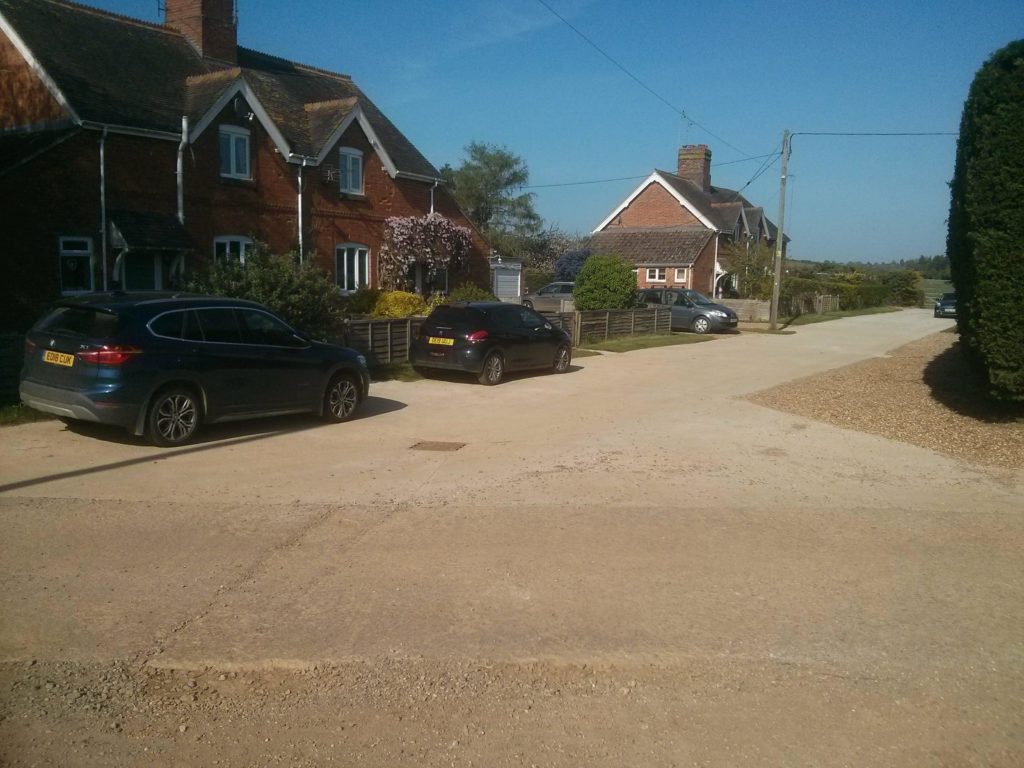
There is still a hamlet of a handful of houses, to the side of the private road which leads to the farm on the other side of the brook. No trace survives however of the chapel or earlier settlement.
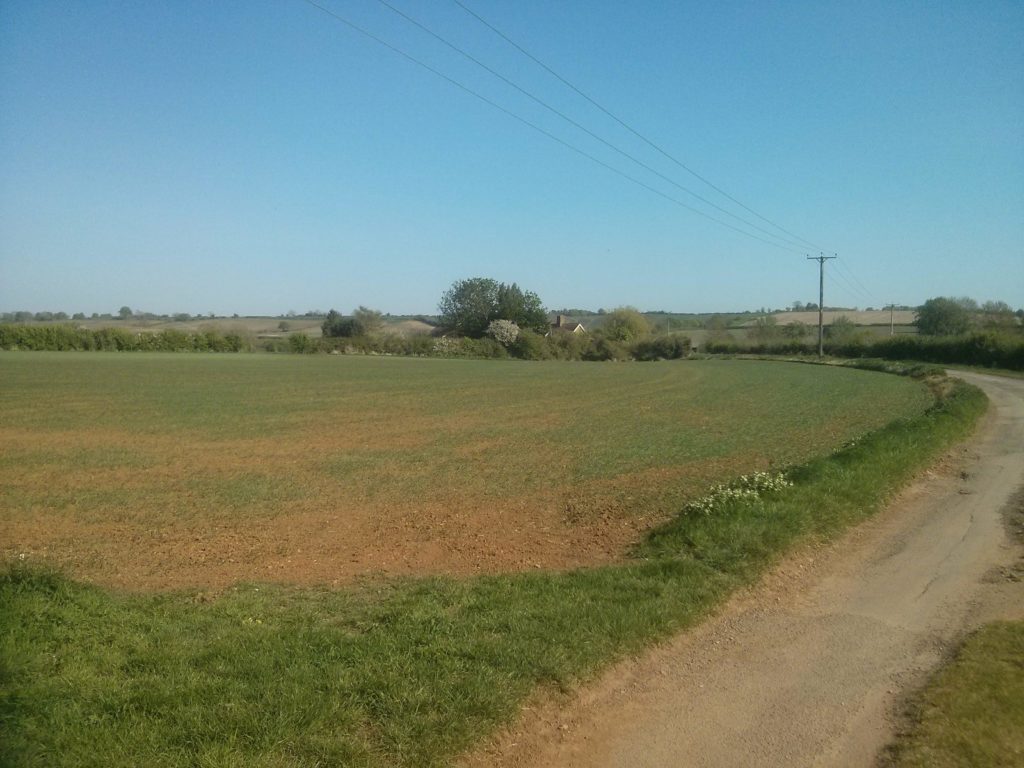
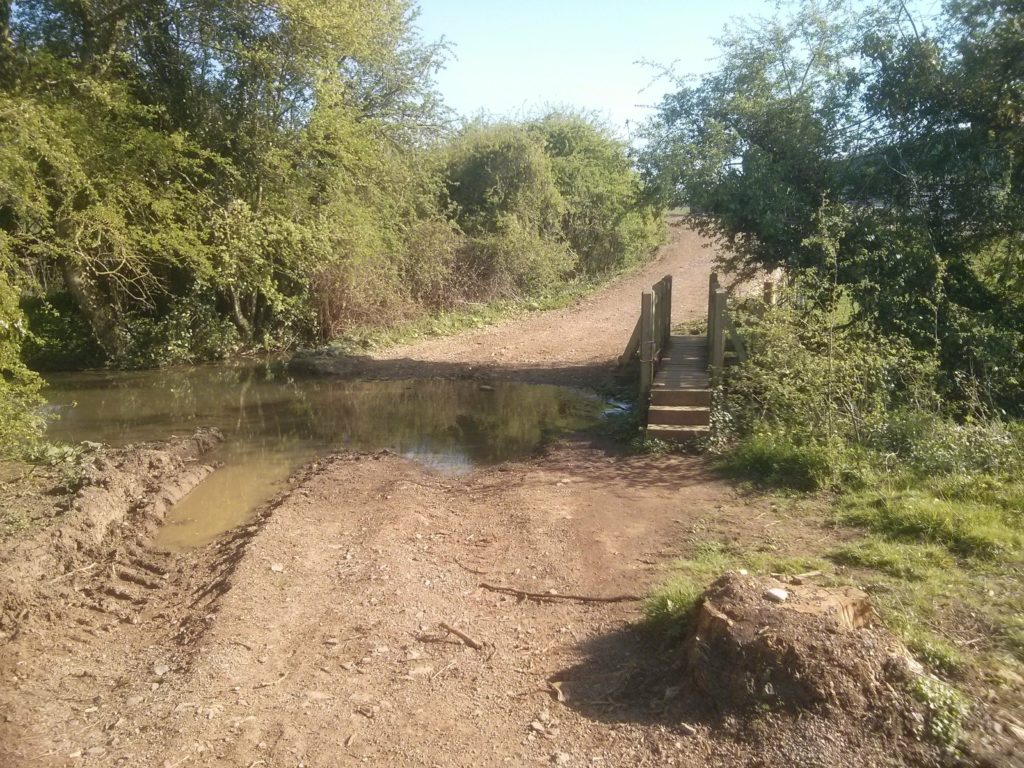
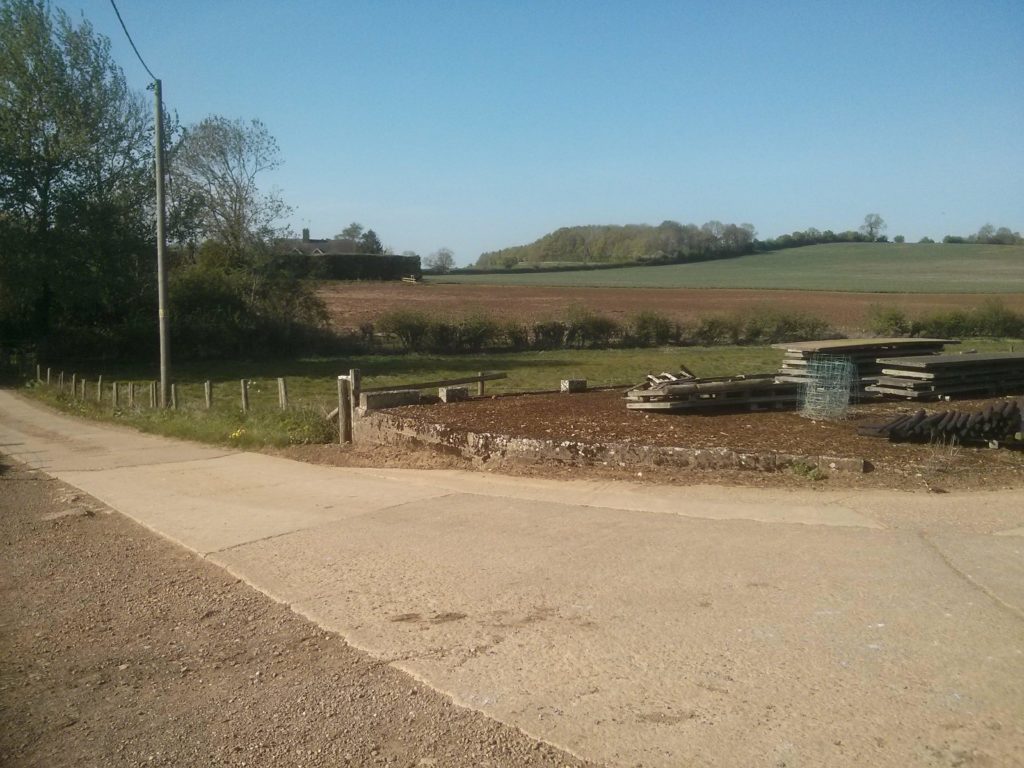
Walton Grounds from the northThe present hamletView of the farm across the brookThe old ford – maybe very old?View of Walton Grounds from the south side of the brookThe return to Kings Sutton
The walk back to Kings Sutton gives a fine view of the church spire. If there was a real minster here in early mediaeval days – and there may well have been – it will most likely have been up on the hill and essentially part of the church. We’ve sited Rumwoldstow down by the meadow, in a fictional Roman fort, because all the high up land is already thoroughly occupied!
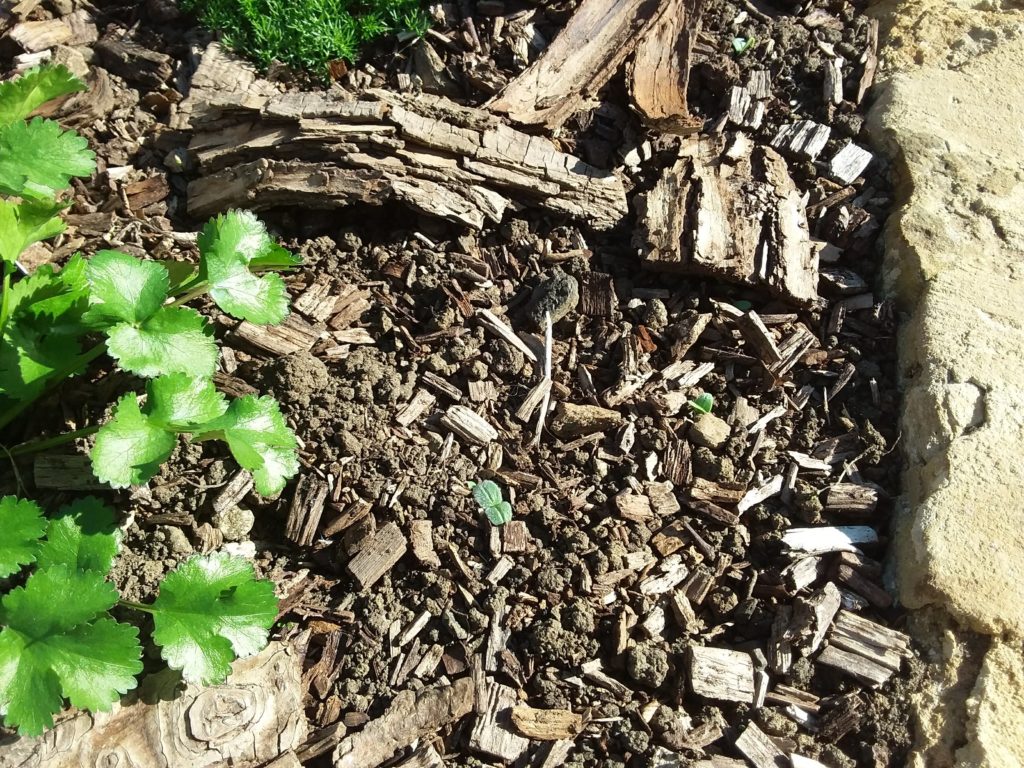
Borage seedlings
Back to the garden – and the borage seedlings are up!
After a good rainy day, we’re back to sunshine with a slightly chilly breeze – perfect seasonal weather for April, which seems strange as it’s so unexpected.
A local farmer has put some sheep on the Rumwoldstow meadow. Lambs! We can hear the baaing from the monastery garden.
In the orchard, the apple trees are coming into bloom, the pears are developing, and the cherry is in flower.
Apple blossom (Wyken pippin)Apple blossom (Hambledon Deux Ans)Pear (Uvedale’s St Germain)Pear with early fruit (Louise Bonne of Jersey)Apple blossom (unspecified)Cherry blossom
Today we have the first proper rain for over a month – how suddenly we went from flood to drought! As the Rumwoldstow garden is made of raised beds, it’s especially important that they receive all the rain they can. So I pottered down the lane in my dressing gown, wellies and waterproof this morning and slipped out most of the roof shingles on the shade garden’s sun hat. I’ll put them back when it’s sunny again.
Sun roof adjusted for rain
Later in the morning, a box of plants arrived in the mail, containing two perennial cauliflowers (a variety developed in 1928, so not historic, but certainly heritage) and a valerian plant which I have planted in the last empty end space. It’s at the north end of the shady bed so will get quite a lot of sunshine.
Valeriana officinalis has a long history as a herbal medicine though I don’t think there’s much evidence for its use as a ‘sleeping tablet’. It certainly didn’t do anything for me, though I do have insomnia at a heroic level – I must have put a lot of points into it, though I’ve no idea why.
The seventeenth century astrological botanist Nicholas Culpeper thought the plant was “under the influence of Mercury, and therefore hath a warming faculty.” He recommended both herb and root, and said that “the root boiled with liquorice, raisons and aniseed is good for those troubled with cough. Also, it is of special value against the plague, the decoction thereof being drunk and the root smelled. The green herb being bruised and applied to the head taketh away pain and pricking thereof.
The south west corner of the main Rumwoldstow garden being shaded by the cloister much of the time, I planted it with shade-loving plants such as sweet woodruff and white horehound. However, as spring draws on, it’s clear that they’ll be exposed to full sunlight for several hours in the middle of the day, which I assume won’t be good for them. So with Al’s help I foraged for materials and built them a little roof.
As you can see in the photo below, the sun is just starting to touch the plants around noon, in mid-April, so they’ll need shading from around this time of year onwards. I cut hazel rods from the hedge which was coppiced two years ago (918), and set four rods with forks into the soil, then laid two long straight rods across.
Basic frame of hazel rods
The next step was to cut roof shingles out of old fence panelling and drill a hole in each to hold a peg cut from hazel. These were laid on the horizontal rods, with additional rods then bound on top to keep them from blowing off.
Wooden shingles with pegsShingles laid on roof
I used garden twine to fix the upper rods and also to bind the corners and add diagonal bracing underneath to give the structure more lateral stability.
Underside of roof
Shingles can be slipped out and rearranged to vary the amount of light that gets through.
Varying the light by removing shingles
In midsummer I may add more shingles to keep the plants cool, but for now this looks like a light woodland effect as the leaves start to grow. In the autumn, I will remove all the shingles and store them indoors.